If the first stars had not yet formed, how can we know what the universe looked like when it was only a few hundred thousand years old?
The answer is microwave background radiation, more commonly called the cosmic microwave background (CMB).
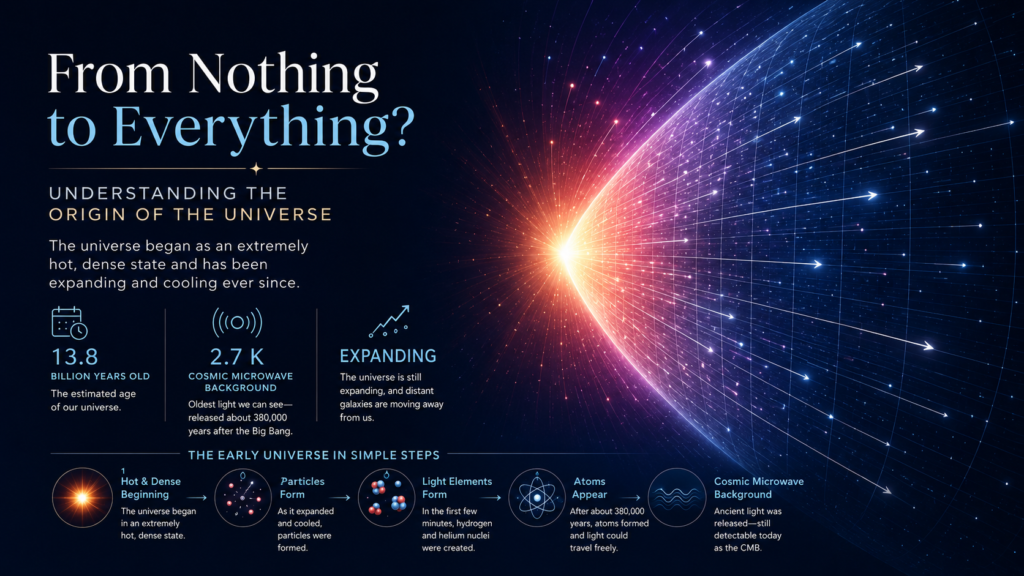
The CMB is ancient electromagnetic radiation that fills the universe. It was released when the young universe had expanded and cooled enough for light to travel freely, roughly 380,000 years after cosmic expansion began. Today, that radiation reaches us as a faint microwave glow with an average temperature of about 2.725 kelvin.
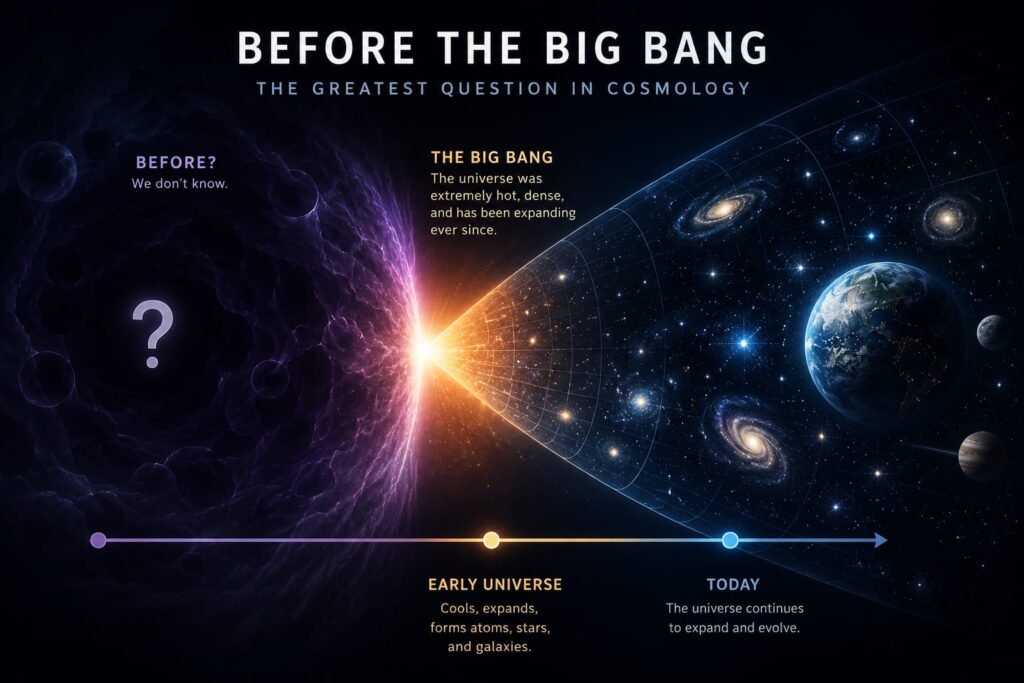
This is not an image of the Big Bang itself. The Big Bang model describes the universe evolving from an extremely hot, dense early state; the CMB comes from a later stage of that evolution.
The universe is now approximately 13.8 billion years old. The CMB gives us a way to study conditions from a time when the cosmos was still extremely young.
So how did this ancient radiation form, and why can scientists still detect it today?
What Is Microwave Background Radiation?
Microwave background radiation is faint electromagnetic radiation left over from the hot, early universe.
It is called the cosmic microwave background radiation, or CMB, because it is observed across the sky and today falls mainly in the microwave part of the electromagnetic spectrum.
The name itself explains three important features of this radiation.
What Does “Cosmic” Mean?
“Cosmic” means that the radiation is associated with the universe on a very large scale.
It does not come from one particular star, planet or galaxy.
When astronomers observe the CMB, they detect it from essentially every direction in the sky. This widespread signal was one of the clues that showed the radiation was not coming from an ordinary astronomical object.
What Does “Microwave” Mean?
“Microwave” describes the wavelengths at which we observe the CMB today.
The radiation was released when the universe was much hotter than it is now. Since then, the universe has expanded, stretching the wavelengths of the photons traveling through space.
As their wavelengths became longer, the radiation shifted into the microwave region of the electromagnetic spectrum.
Today, the CMB has an average temperature of approximately 2.725 K, or about 2.7 degrees above absolute zero. Measurements from the Cosmic Background Explorer (COBE) showed that its spectrum matches an almost perfect blackbody spectrum, the characteristic spectrum of thermal radiation from matter in equilibrium.
What Does “Background” Mean?
“Background” refers to the fact that the radiation is spread across the sky rather than coming from one identifiable source.
It forms a nearly uniform background behind the stars and galaxies we see today.
The CMB is therefore not a single beam of radiation traveling toward Earth. It is ancient radiation arriving from all directions.
In simple terms: The CMB is ancient light from the young universe whose wavelengths have been stretched by cosmic expansion.
How Did the Cosmic Microwave Background Form?
To understand the CMB, we need to go back to a time before stars and galaxies existed.
The early universe was not transparent like the universe around us today.
The Early Universe Was a Hot, Dense Plasma
The young universe was extremely hot and dense.
It contained charged particles, including free electrons, along with atomic nuclei and photons.
A photon is a particle of electromagnetic radiation—the basic unit of light and other electromagnetic radiation.
The problem was that photons could not travel very far without interacting with the free electrons.
They were repeatedly scattered.
A useful analogy is a dense fog. A car’s headlights may produce plenty of light, but the light cannot travel through thick fog in a straight, unobstructed path.
The early universe was somewhat similar: radiation was present, but the charged particles kept scattering the photons.
As a result, the universe was opaque to light.
The Universe Cooled as It Expanded
The universe continued to expand.
As it expanded, its temperature decreased.
Eventually, the temperature became low enough for electrons to combine with atomic nuclei and form mostly neutral atoms, particularly hydrogen.
This stage is commonly called recombination.
The change was important because neutral atoms interact much less strongly with the CMB photons than free electrons did.
The number of free electrons available to scatter photons dropped sharply.
The cosmic fog began to clear.
The Universe Became Transparent
Roughly 380,000 years after cosmic expansion began, the universe had cooled to around 3,000 K.
At this stage, photons were able to travel much more freely through space.
The radiation from this period is what we observe today as the cosmic microwave background.
This gives the CMB a special place in astronomy.
It is not the oldest event we know about. It is the oldest electromagnetic light we can directly observe from the early universe.
Why Is That Radiation Microwave Radiation Today?
When the CMB was released, it was associated with a much hotter environment than today’s universe.
Since then, space itself has expanded.
As the universe expanded, the wavelengths of the photons were stretched.
This stretching is known as cosmological redshift.
A longer wavelength corresponds to lower energy. Over billions of years, the radiation therefore shifted from the much shorter wavelengths associated with its original hot state into the microwave wavelengths we measure today.
That is why the CMB now has a temperature of only about 2.725 K.
The microwave background is therefore not radiation that was originally created as a cold microwave glow. It is ancient radiation whose wavelength has been stretched by the expansion of the universe.
Why Can We See the CMB but Not the Big Bang?
This distinction is essential.
The CMB is not the Big Bang itself.
The Big Bang model describes the early evolution and expansion of the universe from a very hot, dense state. It does not describe an ordinary explosion occurring at one location in pre-existing space.
The CMB comes from a later period, when the universe became transparent to electromagnetic radiation.
The CMB Is Our Earliest Direct View in Electromagnetic Light
Before the CMB was released, photons were constantly interacting with charged particles.
That meant ordinary electromagnetic radiation could not travel freely across the young universe.
Once the universe became transparent, photons could travel across space largely unhindered.
Some of those photons have been traveling ever since.
Today, telescopes can detect them as the cosmic microwave background.
This is why the CMB is sometimes described as a snapshot of the young universe.
It is not a photograph taken with an ordinary camera. It is a map of ancient radiation whose properties preserve information about the conditions of the universe at the time that radiation was released.
Why Can’t We Look Further Back Using Ordinary Light?
The problem is not simply that the earlier universe was too distant.
Before the universe became transparent, light could not travel freely through it.
So even if a telescope were sensitive enough, ordinary electromagnetic observations could not simply look through that early plasma and reveal what was happening at earlier times.
The CMB marks a practical electromagnetic boundary for observations of the early universe.
There are other ways scientists study even earlier conditions, such as theoretical models and searches for other cosmic signals, but those involve different evidence and should not be confused with directly seeing the universe before the CMB.
What Does the CMB Look Like?
CMB maps often appear as colorful patterns covering the entire sky.
But the colors can be misleading if they are interpreted literally.
The CMB is extraordinarily uniform.
The Tiny Temperature Differences
The average CMB temperature is about 2.725 K, but it is not exactly the same in every direction.
The temperature variations are extremely small—about one part in 100,000.
These differences are called anisotropies.
In simple terms, some regions of the young universe were slightly hotter or colder than others.
For comparison, NASA’s WMAP measurements show examples of temperatures around 2.7251 K in one direction and 2.7249 K in another. The difference is tiny, but it carries useful information about the early universe.
Why Do CMB Maps Have Bright Colors?
The dramatic colors in CMB maps are not what the early universe would have looked like to human eyes.
Scientists enhance the tiny temperature differences so that they can be displayed and studied.
Without this enhancement, the CMB would look almost completely uniform.
This is an important point when interpreting famous CMB images: a large red or blue region on a map does not mean that region was thousands of degrees hotter or colder than its surroundings.
The actual differences are extremely small.
What Do These Variations Tell Us?
The variations are important because they reflect differences in the distribution of matter and energy in the young universe.
Some regions were slightly denser than others.
These small differences became the starting points for later cosmic structure. Over much longer periods, gravity helped amplify differences in the distribution of matter, contributing to the formation of the large-scale structures we see today.
Exactly how those primordial fluctuations originated is a deeper question involving models of the very early universe, including inflation.
Inflation is a proposed period of extremely rapid expansion in the early universe. It is an important theoretical framework in modern cosmology, but details of how inflation occurred and what physical mechanism caused it remain active areas of research.
For this article, the important point is simpler: the CMB contains measurable variations, and those variations provide evidence about the conditions from which later cosmic structure developed.
How Did Scientists Discover the Cosmic Microwave Background?
The CMB was discovered through an unexpected signal.
The Unexpected Signal
In the 1960s, radio astronomers Arno Penzias and Robert Wilson were using a sensitive horn antenna at Bell Laboratories.
They detected a persistent microwave signal that appeared to come from all directions.
The signal was stronger than expected and did not disappear when they investigated possible sources of interference.
Their observations eventually established that the signal was cosmic rather than a problem with the equipment.
Penzias and Wilson were awarded the 1978 Nobel Prize in Physics for their discovery of cosmic microwave background radiation.
From a Mysterious Signal to Precision Measurements
The discovery raised an important question: what exactly were the properties of this cosmic radiation?
Later missions answered that question with increasing precision.
COBE → WMAP → Planck
COBE, launched in 1989, measured the CMB’s spectrum and showed that it closely follows a nearly perfect blackbody curve with a temperature of about 2.725 K. It also detected the tiny temperature variations in the CMB.
WMAP then measured those variations in much greater detail, helping scientists determine important properties of the universe such as its matter content, age and geometry.
The European Space Agency’s Planck mission made even more detailed measurements of the CMB, producing a highly precise map of its temperature variations.
The significance of these missions is not simply that they produced increasingly beautiful maps.
They allowed scientists to test cosmological models against increasingly precise observations.
What Does Microwave Background Radiation Tell Us About the Universe?
The CMB is valuable because it contains information about a very young universe.
It Gives Us a Snapshot of the Young Universe
The CMB provides a view of the universe at roughly 380,000 years after cosmic expansion began.
At that time, there were no stars shining like the stars we see today.
The universe was still dominated by hot matter and radiation, and it had only recently become transparent.
Compared with today’s approximately 13.8-billion-year-old universe, this was an extremely early stage.
It Shows That the Young Universe Was Very Smooth
The CMB is remarkably uniform across the sky.
But it is not perfectly uniform.
Those tiny deviations from uniformity tell scientists that the early universe contained small differences in density and temperature.
That combination—large-scale smoothness with small fluctuations—is an important feature of the young cosmos.
It Helps Scientists Measure the Universe
The CMB contains information that can be used to constrain fundamental properties of the universe.
Measurements of its temperature pattern and other characteristics help scientists determine quantities related to the universe’s matter content, geometry, age and large-scale evolution.
This is one reason CMB research has become such an important part of modern cosmology.
Scientists are not simply looking at an old glow.
They are measuring its properties and comparing those measurements with predictions from physical models.
It Supports the Hot Big Bang Picture
The CMB is one of the strongest observational foundations of the hot Big Bang picture.
Its nearly perfect thermal spectrum and the detailed pattern of its temperature variations are consistent with a universe that was once much hotter and denser and has expanded and cooled over time.
But scientific precision matters here.
The CMB does not mean that every detail about the earliest universe is known.
It also does not tell scientists exactly what happened at a hypothetical “time zero,” nor does it establish that the universe came from nothing.
Instead, it provides strong observational evidence about a much later stage of the universe’s early evolution.
That distinction separates what observations directly tell us from questions that remain theoretical.
Why Is the Cosmic Microwave Background Important?
The CMB gives scientists something rare in astronomy: directly measurable evidence from a very early stage of cosmic history.
Astronomers can measure its temperature, spectrum and tiny variations.
They can compare those measurements with predictions from cosmological models.
That process helps scientists determine which models are consistent with observations and which are not.
The CMB is sometimes compared with a fossil record, but the comparison should not be taken literally.
A fossil preserves physical evidence of ancient life.
The CMB preserves information about the physical conditions of the young universe in the form of ancient radiation.
The remarkable part is that this radiation has traveled across an expanding universe for billions of years, yet it still carries measurable information about the conditions that existed when it was released.
Frequently Asked Questions About Microwave Background Radiation
What Is Microwave Background Radiation?
Microwave background radiation is ancient electromagnetic radiation released when the universe became transparent roughly 380,000 years after cosmic expansion began. Today, cosmic expansion has stretched its wavelengths into the microwave region, and its average temperature is about 2.725 K.
Why Is the Cosmic Microwave Background Called Microwave Radiation?
It is called microwave radiation because the expansion of the universe has stretched the wavelengths of this ancient radiation into the microwave part of the electromagnetic spectrum.
How Old Is the Cosmic Microwave Background?
The CMB radiation we observe was released roughly 380,000 years after cosmic expansion began. The universe itself is approximately 13.8 billion years old.
What Temperature Is the CMB?
The average temperature of the cosmic microwave background is approximately 2.725 K, or about 2.7 degrees above absolute zero.
Can We See the Big Bang Through the CMB?
No.
The CMB does not show the Big Bang itself. It shows radiation from roughly 380,000 years after cosmic expansion began, when the universe became transparent to electromagnetic radiation.
Who Discovered the Cosmic Microwave Background?
Arno Penzias and Robert Wilson discovered the cosmic microwave background radiation in the 1960s while studying an unexplained microwave signal. They received the 1978 Nobel Prize in Physics for the discovery.
Why Is the CMB Important?
The CMB provides a detailed record of the young universe. Its temperature, spectrum and tiny variations help scientists study the early distribution of matter and energy and constrain important properties of the universe.
Conclusion: Reading the Universe’s Oldest Light
The universe today is filled with stars, galaxies and enormous structures, but it did not always look this way.
Long before the first stars formed, the universe was hot, dense and opaque to light. As it expanded and cooled, electrons combined with atomic nuclei, reducing the scattering of photons and allowing light to travel freely.
That ancient radiation is still reaching us.
We detect it today as the cosmic microwave background.
The CMB does not show the Big Bang itself, and it does not answer every question about the earliest moments of the universe. What it does provide is something scientists can actually measure: a detailed record of the young cosmos from roughly 380,000 years after cosmic expansion began.
Its almost uniform temperature tells us that the young universe was remarkably smooth.
Its tiny variations tell us that it was not perfectly smooth.
Those small differences contain the beginnings of a much larger story—the transition from a young, nearly uniform universe to one filled with stars, galaxies and cosmic structure.
The next part of that story begins with a simple question:
How did the first stars emerge from a universe that once had no stars at all?