What Happened Before the Big Bang? Exploring One of Science’s Biggest Questions
If the universe had a beginning, what existed before it?
It sounds like a simple question, but answering it is surprisingly difficult. When we ask what happened before the Big Bang, we are not simply asking what filled an empty space. We are asking something deeper: did space and time themselves exist in the way we understand them today?
The Big Bang model describes the universe in its early, extremely hot and dense state and how it subsequently expanded and cooled. Scientists have strong evidence for this early history, including the expansion of the universe and the cosmic microwave background. But these observations do not give us a confirmed picture of what, if anything, came before that early state.
Imagine watching the first recorded scene of a movie. You can learn a great deal about everything that happens afterward, but the first scene does not automatically tell you whether another scene existed before it.
So, what does science actually say about before the Big Bang?
What Is the Big Bang?
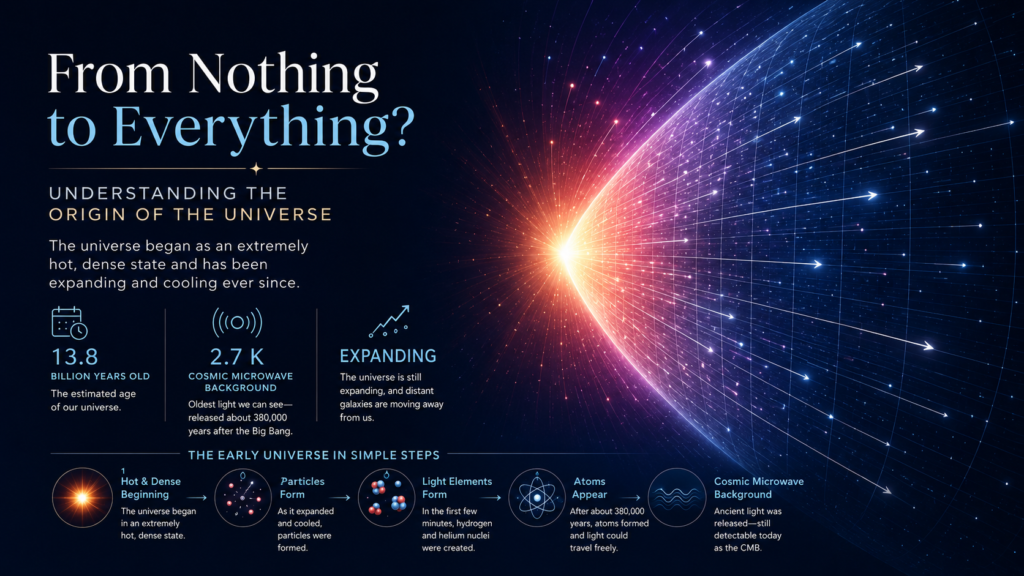
The Big Bang is the scientific model that describes the early evolution of our universe. It tells us that the universe was once much hotter and denser than it is today and that it has been expanding and cooling over time.
As the universe cooled, conditions changed. Particles formed, atoms eventually appeared, and much later the first stars and galaxies developed. Over billions of years, this cosmic evolution eventually led to the universe we observe today.
But there is an important point to understand:
The Big Bang was not an explosion of matter from one location into pre-existing empty space.
The Big Bang Was Not an Explosion
A useful analogy is a balloon with dots drawn on its surface. As the balloon is inflated, the distance between the dots increases. The dots are not simply being thrown away from one particular point; the surface between them is expanding.
The expanding universe is somewhat similar. On large scales, galaxies become farther apart as space itself expands.
However, the balloon analogy has limits. The universe is not expanding into some surrounding empty space in the same way a balloon expands into a room. The analogy is useful only for visualizing how distances between objects can increase as space expands.
The early universe was very different from the universe we see today:
- It was extremely hot and dense.
- It has expanded and cooled over cosmic time.
- Stars and galaxies formed much later as matter came together under gravity.
Scientists can reconstruct much of this early history using observations such as the cosmic microwave background (CMB), the faint radiation left from an early stage of the universe.
But there is a limit to what this evidence tells us. The Big Bang model explains a great deal about the universe’s early evolution, but it does not provide a confirmed answer to what happened before that early state.
That is where the question becomes much more difficult—and much more interesting.
Why Is “Before” a Difficult Question?
When we ask, “What happened before the Big Bang?”, we are using before in the everyday sense: one event happens, and another happens afterward.
But at the earliest stages of the universe, that familiar idea may not work.
According to Einstein’s theory of relativity, space and time are connected as spacetime. Time is not simply a separate clock operating outside the universe. It is part of the physical description of the universe itself.
Time May Have Begun With the Big Bang
One possibility explored in cosmology is that time, as described by our current theories, has a beginning associated with the earliest state of the universe.
If that were the case, asking what happened “before” the Big Bang might be like asking about an event at a time that does not exist.
A simple analogy is the North Pole. You can travel north until you reach the North Pole, but asking, “What is farther north than the North Pole?” stops making sense because there is no farther north on Earth’s surface.
The same analogy helps illustrate the problem with the word before:
- If time had a beginning, there may be no earlier moment.
- The word “before” depends on time existing.
- This does not prove that absolutely nothing existed before the Big Bang.
That last point is important. Scientists have not established that “nothing existed before the Big Bang.” Rather, one possibility is that our ordinary concept of before may not apply.
Other theoretical models propose that our universe could have emerged from an earlier state. These possibilities are still being investigated.
Scientific Ideas About What Came Before the Big Bang
So, what might have existed before the Big Bang?
Science does not currently have one confirmed answer. Instead, physicists and cosmologists have developed different models that explore possible scenarios.
These ideas must be separated carefully from established evidence. Some are serious areas of theoretical research, while others remain highly speculative.
No “Before” Existed
The simplest possibility is that there was no earlier time.
If time had a beginning with the universe’s earliest state, then there would be no previous moment in which another event could happen.
In this view, asking what happened before the Big Bang may be asking a question that does not have the usual meaning we expect.
But remember: this is not the same as proving that there was “nothing.” It is a statement about whether an earlier time existed.
Cyclic Universe Theory
Another possibility is that our universe was not the first cosmic phase.
Some cyclic universe models explore the possibility that the universe passes through repeated stages rather than having a single beginning.
A simplified picture might look like:
Expansion → contraction → new expansion → contraction → …
In such a model, the Big Bang could represent a transition from an earlier cosmic phase into the expanding universe we observe.
These models are scientifically interesting, but they are not established descriptions of what actually happened.
Quantum Universe Ideas
At extremely small scales, nature behaves according to quantum physics, which can differ greatly from our everyday experience.
Some theoretical models explore whether quantum processes could have played a role in the universe’s origin. In certain models, our universe could emerge from an earlier quantum state or through a process that does not resemble an ordinary beginning.
These ideas are part of ongoing theoretical research. Scientists do not currently have direct observational evidence showing that one particular quantum-origin model is the correct explanation for our universe.
Multiverse Ideas
Another possibility discussed in some areas of theoretical physics is the multiverse—the idea that our observable universe might be one of many universes.
Some theoretical frameworks allow scenarios in which different universes could exist, potentially with different properties or histories.
But there is an important distinction:
The multiverse is a hypothesis, not an established fact.
Scientists are still investigating whether such scenarios are physically possible and whether they could produce testable predictions.
So it would be misleading to say that scientists have discovered other universes. They have not.
What Evidence Do Scientists Have?
If scientists do not know what happened before the Big Bang, how do they know anything about the universe’s early history?
The answer is evidence.
Several independent observations strongly support the idea that the universe was once much hotter and denser and has been expanding and cooling over time.
But these observations mainly tell us about the early universe. They do not provide a confirmed answer about what, if anything, came before it.
Cosmic Microwave Background
One of the strongest pieces of evidence is the cosmic microwave background (CMB).
The CMB is faint radiation that fills space and comes from an early stage of the universe, when it had cooled enough for light to travel freely through matter.
Today, telescopes detect this ancient radiation in every direction. Its properties closely match what scientists expect from a hot, dense early universe.
You can think of it as an afterglow from the universe’s early history. By studying it, scientists can learn about conditions when the universe was still very young.
The Expansion of the Universe
Scientists observe that, on very large scales, the distances between galaxies generally increase over time. This is evidence that the universe is expanding.
If we use our understanding of cosmic expansion to trace the universe’s history backward, we find that the universe was once considerably hotter and denser.
This is one reason the Big Bang model is so successful: it explains many observations about the universe’s early state and subsequent evolution.
Early Element Formation
The amounts of some of the universe’s lightest elements provide another important clue.
During the first few minutes of cosmic history, the universe was hot and dense enough for nuclear reactions to produce elements such as hydrogen and helium, along with very small amounts of lithium and other light nuclei.
The predicted abundances of these primordial elements broadly agree with observations.
This provides another important piece of evidence for a hot, dense early universe.
But What Does This Evidence Actually Tell Us?
This distinction is essential.
Evidence supports:
- ✅ The universe was once much hotter and denser than it is today.
- ✅ The universe has been expanding and cooling.
- ✅ The early universe produced many of the light elements observed today.
- ✅ The Big Bang model successfully describes much of the universe’s early history.
Evidence does not currently establish:
- ❌ What happened before the Big Bang.
- ❌ Whether there was a previous universe.
- ❌ Whether time existed in some form before the earliest stage described by our current theories.
So when scientists say that the Big Bang model is strongly supported by evidence, they are not claiming that science has discovered what happened before it.
That distinction between what we know, what we infer, and what we are still investigating is essential to understanding modern cosmology.
Why This Question Matters—and What We Still Don’t Know
The question of what happened before the Big Bang sits near the limits of what current science can explain.
Scientists have developed an extraordinarily detailed picture of the universe’s early history using observations such as cosmic expansion, the cosmic microwave background, and the formation of light elements. Yet these observations do not tell us with certainty whether there was anything “before” the Big Bang—or whether the word before even applies at that boundary.
Trying to answer the question pushes scientists to examine some of the deepest ideas in physics:
- Time: Did time have a beginning, or was there an earlier phase?
- Space: How did the universe’s space develop and expand?
- Physics: Are our current theories enough to describe the universe’s earliest conditions?
- Origins: Was the Big Bang an absolute beginning, or could it have been part of a larger cosmic history?
Several possibilities have been proposed, including no earlier time, cyclic models, quantum-origin ideas, and multiverse scenarios. But none currently provides a confirmed answer to what came before our universe.
And this is an important lesson about science: an unanswered question is not necessarily a failure of science.
It is an indication that there is still something to investigate, test, and understand.
The Big Bang model tells us an extraordinary amount about the universe’s early history. But what, if anything, came before it remains one of the greatest unanswered questions in cosmology.
Some mysteries are not signs of failure—they are invitations to explore further.
Frequently Asked Questions
Did the Big Bang happen at one point in space?
Not in the way an ordinary explosion does. The Big Bang describes the early universe as a whole, with space expanding over time rather than matter exploding outward from a single location into pre-existing space.
Was there anything before the Big Bang?
We do not know. One possibility is that there was no earlier time. Other theoretical models propose an earlier cosmic state, but none has been confirmed.
Did time begin with the Big Bang?
It is possible that time, as described by our current theories, has a beginning associated with the universe’s earliest state. However, this is an area where our current understanding of physics is incomplete.
Is the multiverse proven?
No. The multiverse is a hypothesis arising from certain theoretical ideas. There is currently no confirmed observational evidence establishing that other universes exist.
What is the strongest evidence for the Big Bang?
Several observations support the Big Bang model, including the expansion of the universe, the cosmic microwave background, and the observed abundances of light elements produced in the early universe.
Does the Big Bang explain the absolute beginning of everything?
Not necessarily. The Big Bang model successfully describes much of the universe’s early evolution, but it does not by itself establish what, if anything, preceded that early state.