From Nothing to Everything? Understanding the Origin of the Universe
How did everything we can see—galaxies, stars, planets and eventually life—come to exist?
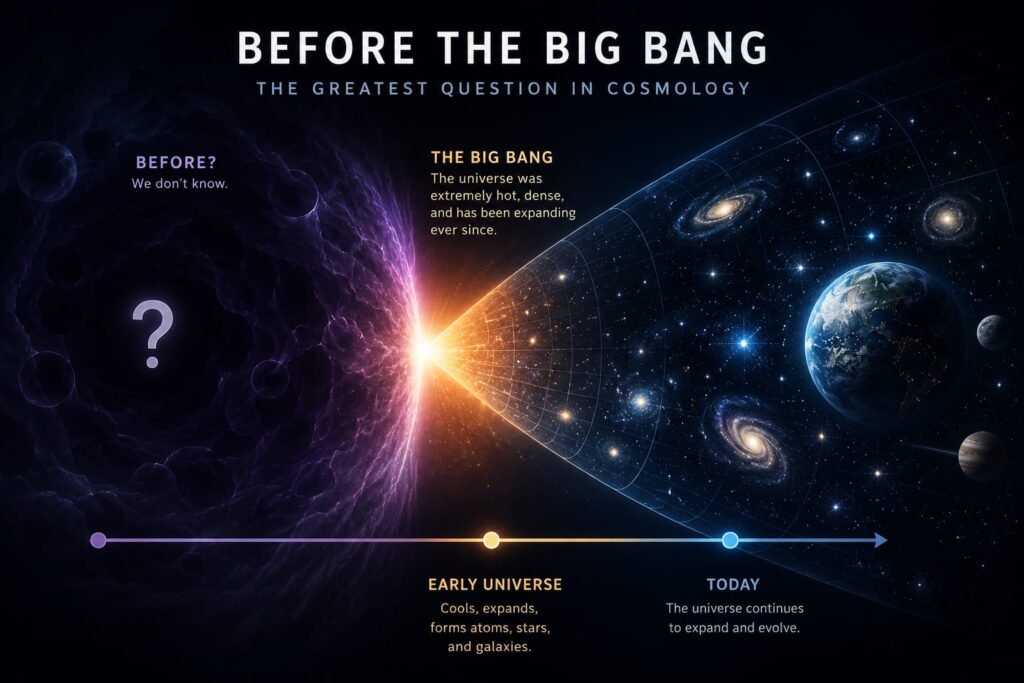
That question takes us to the origin of the universe, but answering it requires an important distinction. Scientists can describe a great deal about how the early universe evolved from an extremely hot, dense state into the vast cosmos we observe today. They can use observations, physical laws and mathematical models to reconstruct much of that history.
But science does not yet have a complete answer to the deeper question of why the universe exists at all, or what—if anything—can meaningfully be described as existing before its earliest known state.
The story we can investigate begins with the Big Bang. Not as an explosion occurring at one particular location, but as the early expansion of the universe itself. As the universe expanded, it cooled. Particles formed, light elements were produced, atoms appeared, and gravity gradually brought matter together to form stars and galaxies.
A few facts give us a sense of the scale involved:
- The universe is about 13.8 billion years old according to the standard cosmological model.
- The cosmic microwave background (CMB) is ancient light released when the universe became transparent, roughly 380,000 years after the Big Bang.
- The universe is still expanding today, and observations of distant galaxies provide one of the key lines of evidence for this expansion.
Imagine taking a movie of the universe and running it backward. Galaxies that are now separated by enormous distances would appear progressively closer together. The universe would become hotter and denser as we go further back in time.
That backward reconstruction is one reason scientists can investigate the early universe even though nobody was there to observe it directly.
But there is a common mistake here: the Big Bang should not be imagined as a ball of matter exploding outward from a central point into empty space. There is no known center of the universe from which everything flew outward. Instead, the distances between large-scale structures increase because space itself is expanding.
The previous part of this series explored what could have preceded the Big Bang and why ideas about “before” the universe are difficult to test. This article moves forward from that boundary: what happened as the early universe expanded, and how did that simple, hot beginning eventually lead to the complex universe we see today?
What Does “Origin of the Universe” Actually Mean?
The phrase origin of the universe sounds like it describes one event, but it actually covers several different questions.
When scientists talk about the beginning of the universe, they are not necessarily answering the same question that a philosopher or a curious reader might have in mind.
Are we asking when the universe began? How far back can we observe? Or are we asking what caused space, time, matter and energy to exist in the first place?
These questions overlap, but they are not identical.
Are we asking when the universe began?
The standard cosmological model places the age of the universe at about 13.8 billion years.
But this does not mean scientists can directly observe the exact moment the universe began.
It helps to separate three ideas:
- The age of the universe: About 13.8 billion years—the estimated time since the hot, dense early state described by modern cosmology.
- The beginning of its observable history: The oldest light we can directly observe is the cosmic microwave background, released roughly 380,000 years after the Big Bang. Earlier stages are reconstructed using physics and indirect evidence.
- The ultimate origin of space and time: This is a much deeper question. Current physics does not provide a complete, experimentally confirmed explanation of what ultimately caused the universe to exist—or whether asking what happened “before” the earliest universe is even meaningful.
A simple example is a movie whose opening scenes are missing. You may be able to reconstruct much of what happened earlier from everything that follows, but you cannot honestly say that you watched those missing scenes.
Cosmology works somewhat like this. Scientists use observations of the universe today to reconstruct its earlier history. The further back they go, however, the more they encounter the limits of current physics.
What can science actually investigate?
Science is strongest when a question leads to observable and testable consequences.
Scientists can measure the expansion of the universe, study the CMB, determine the abundance of light elements and examine how galaxies are distributed. These observations allow cosmologists to test models of how the early universe evolved.
But there is an important boundary:
Science can test ideas that leave observable evidence; it cannot turn an untestable possibility into an established scientific fact.
This matters when discussing ideas about what might have preceded the Big Bang. Some scientific models explore an earlier phase, a cosmic bounce or other possibilities, but these should not be presented with the same confidence as observations such as cosmic expansion and the CMB.
So when we talk about the origin of the universe, we need to be precise about what we mean.
How did the early universe evolve? This is a question science can investigate with substantial evidence.
Why does the universe exist at all? That is a much deeper question for which we do not yet have a complete scientific answer.
With that distinction in place, we can look at the Big Bang itself.
The Big Bang Theory Explained Simply
The phrase Big Bang can create the wrong picture. It sounds like a gigantic explosion that happened somewhere in an already existing universe.
That is not what modern cosmology means by the term.
What the Big Bang actually means
The Big Bang describes the early, hot, dense and expanding state of the universe.
As the universe expanded, its temperature and density decreased. Within the first few minutes, conditions became suitable for the formation of the nuclei of light elements such as hydrogen and helium. Much later, atoms formed, followed by the first stars and galaxies.
So rather than imagining matter exploding outward from one location, it is more accurate to think of the universe itself evolving and expanding from an extremely hot, dense early state.
This distinction is important because an ordinary explosion has a center: material moves outward from that point into the surrounding space.
The Big Bang does not fit that picture.
Did the universe expand into something?
This is one of the most natural questions to ask:
If the universe expanded, what was it expanding into?
The difficulty is that space is part of the universe. The Big Bang model does not require an empty space outside the universe waiting to be filled.
A useful, though imperfect, analogy is the surface of a balloon. Imagine drawing several dots on the balloon and then inflating it. As the balloon expands, every dot becomes farther from the others.
From the perspective of the dots on the surface, there is no single dot that acts as the center of expansion.
But the analogy has limits. The real universe is not the surface of a balloon, and we do not need to imagine the universe expanding into some larger surrounding space.
The analogy simply helps visualize how distances between objects can increase because space itself expands.
Where did the Big Bang happen?
Everywhere.
There is no special location in today’s universe that can be identified as the place where the Big Bang happened.
Every large-scale region of the universe was part of the early hot, dense state.
Imagine reversing cosmic expansion. Galaxies that are widely separated today become progressively closer together as we trace the universe backward. An observer in another galaxy would see the same broad pattern: distant galaxies would appear to be moving away from them too.
That is why the Big Bang should not be pictured as a fireball expanding from a central point.
The important story is not where an explosion happened, but how the universe changed as space expanded and the cosmos cooled.
And that cooling set the stage for the next major chapter: the formation of particles, atoms, stars and eventually galaxies.
A Timeline of the Early Universe
Once we stop thinking of the Big Bang as an explosion, the early universe becomes easier to understand as a story of expansion and cooling.
The universe did not become complex all at once. It passed through a sequence of stages, with each stage making the next one possible.
The earliest moments
The earliest part of this story is also the part we understand least.
Our current theories can describe the universe at extremely early times, but they do not provide a complete, experimentally tested description of the ultimate beginning.
One proposed stage is cosmic inflation—a very brief period of extraordinarily rapid expansion. Inflation is included in many modern cosmological models because it can help explain several large-scale properties of the universe, including its remarkable uniformity.
However, scientists still do not know exactly what caused inflation or whether a deeper process preceded it.
The first particles
As the universe expanded and cooled, its conditions changed dramatically.
The early universe was filled with an extremely energetic mixture of particles and radiation. Fundamental particles could interact intensely, and as temperatures fell, the ingredients needed for later atomic nuclei became possible.
There were still no stars, planets or atoms. The universe was far too hot for such structures to exist.
The first atomic nuclei
Within the first few minutes, the universe had cooled enough for protons and neutrons to combine into the nuclei of light elements, mainly hydrogen and helium, along with tiny amounts of other light elements.
This process is known as Big Bang nucleosynthesis.
It is important evidence for the Big Bang because calculations based on the conditions of the early universe predict particular proportions of these light elements, broadly matching what astronomers observe.
The universe, however, was still not transparent. Electrons remained free and interacted frequently with light.
The first atoms
For roughly the first 380,000 years, the universe remained a hot plasma.
Eventually, continued expansion lowered the temperature enough for electrons to combine with atomic nuclei and form neutral atoms, primarily hydrogen.
With far fewer free electrons available to scatter photons, light could finally travel freely through space.
That ancient light is what we now detect as the cosmic microwave background, or CMB.
It is the oldest light we can observe and provides one of our clearest windows into the early universe.
From this point, the universe entered a much longer stage before the first stars appeared.
How Do We Know the Big Bang Happened?
The Big Bang is not accepted simply because it provides a convenient story about the beginning.
Its strength comes from the fact that different observations point toward the same broad picture.
Three pieces of evidence are especially important.
The expansion of the universe
When astronomers observe distant galaxies, their light is generally shifted toward longer, redder wavelengths. This phenomenon, called cosmological redshift, is connected with the expansion of space.
On large scales, the farther away a galaxy is, the faster it tends to be receding from us.
This does not mean Earth sits at the center. An observer in another galaxy would see a similar large-scale pattern.
If we trace this expansion backward, the universe becomes progressively denser and hotter. This leads naturally to the hot early state described by the Big Bang model.
The cosmic microwave background
The CMB is sometimes described as a baby picture of the universe.
It was released when the universe was about 380,000 years old. Today, cosmic expansion has stretched that radiation into microwave wavelengths, and it has cooled to a temperature of roughly 2.7 kelvin.
The CMB is not perfectly uniform. It contains tiny variations in temperature and density.
Those small differences are important because they represent early variations that later grew through gravity into the much larger structures we see today.
The abundance of light elements
The early universe acted as a natural nuclear laboratory.
During its first few minutes, conditions allowed light nuclei to form. When scientists calculate how much hydrogen, helium and other light elements should have been produced, the results broadly agree with observations.
This is significant because the Big Bang model does not merely say that the universe was once hot. It makes predictions about what that hot beginning should have left behind.
Together, cosmic expansion, the cosmic microwave background and the abundance of light elements provide a remarkably consistent picture of a hot, dense early universe.
What Happened Before the Big Bang?
This is where the answer becomes much less certain.
It is tempting to ask what happened before the Big Bang in the same way we ask what happened before sunrise. But the word “before” assumes that time already existed in the usual sense.
If our current description of the universe breaks down when we approach its earliest boundary, we cannot simply extend today’s understanding of time backward indefinitely.
Scientists have proposed models that explore possibilities beyond the standard early-universe picture. Some describe an earlier cosmic phase or a possible cosmic bounce.
But these ideas should be treated differently from observations such as cosmic expansion and the CMB. They are attempts to answer questions that current evidence has not settled.
So the scientifically honest answer is:
We don’t yet know what, if anything, preceded the earliest state that our current theories can reliably describe.
That uncertainty is not a failure of cosmology. It is an example of how science works: when evidence is insufficient, scientists distinguish what is known from what remains hypothetical.
Was the Universe Created From Nothing?
The word “nothing” causes a surprising amount of confusion in discussions about the universe.
In everyday language, nothing means the complete absence of everything—no matter, no energy, no space, no time and no physical laws.
In physics, however, “nothing” can sometimes refer to a vacuum state that still has physical properties and is governed by physical laws.
Those two meanings are not equivalent.
So when someone says, “The universe came from nothing,” an important question follows:
What exactly do they mean by “nothing”?
Current cosmology does not provide a confirmed explanation showing that the entire universe emerged from absolute philosophical nothingness.
The Big Bang model primarily describes the evolution of the early universe from a very hot, dense state. It does not, by itself, answer the ultimate philosophical question of why there is a universe at all.
That distinction is easy to lose in popular explanations, where “Big Bang” and “creation of everything from nothing” are sometimes treated as the same idea.
They are not.
What Came First: Space, Time or Matter?
This question sounds straightforward, but it takes us close to the limits of modern physics.
In Einstein’s theory of general relativity, space and time are connected as spacetime, and the geometry of spacetime is related to matter and energy.
The expansion of the universe, therefore, is not simply matter moving through an unchanging stage. The distances that define the large-scale structure of the universe change as the universe evolves.
This creates a problem when we try to imagine the very beginning.
If time itself is part of the physical system we are trying to describe, asking “What happened before time began?” may not have the same meaning as asking what happened yesterday.
A simple analogy is a map whose edge marks the limit of the territory it describes. Asking what lies “north” beyond the northernmost point may not have a useful answer within that map.
The analogy does not prove that time definitely began at a particular moment. It simply illustrates why ordinary ideas about before and after become difficult when we approach the limits of our current theories.
A complete description of the earliest universe may eventually require a theory that successfully combines quantum mechanics and gravity—something physics has not yet achieved.
How Old Is the Universe?
The universe is approximately 13.8 billion years old.
Scientists estimate this age using observations and cosmological models, including measurements of the universe’s expansion and the properties of the cosmic microwave background.
There is another important detail: looking farther away in space means looking farther back in time.
Light takes time to travel. When we observe a galaxy billions of light-years away, we see it as it was billions of years ago, not as it is today.
This makes astronomy unusual. Telescopes do not simply look across space—they also look into the history of the universe.
The CMB takes this even further. It allows us to observe the universe at an age of roughly 380,000 years, long before stars and galaxies existed.
The Origin of the Universe vs. the Origin of Life
The two questions are connected, but they are not the same.
The origin of the universe asks how the cosmos evolved from its earliest known state and how structures such as galaxies, stars and planets eventually formed.
The origin of life asks how living systems first emerged under suitable conditions on a planet.
There is an enormous amount of history between these questions.
First came the early universe. Then came atoms, stars and galaxies. Stars produced heavier elements through nuclear processes, and those elements later became part of new generations of stars and planets.
Eventually, around one ordinary star, a planet formed that became Earth.
So understanding the universe’s beginning provides the cosmic setting in which everything else became possible.
It does not, by itself, explain how life began.
What Scientists Still Don’t Know
For all the progress cosmology has made, the origin of the universe is far from a finished story.
We have strong evidence for the universe’s expansion, its hot early state and the cosmic microwave background. We can reconstruct much of its history from the first few minutes onward.
But several major questions remain open:
- What caused cosmic inflation, if inflation occurred?
- What happened at the earliest point our current theories can no longer describe reliably?
- Why is there much more matter than antimatter?
- What is the true nature of dark matter and dark energy?
- What theory can successfully unite quantum mechanics and gravity?
These are not minor details at the end of an otherwise complete explanation. They sit close to the boundary between what modern physics can explain and what it cannot yet test.
And that is perhaps the most important lesson from studying the origin of the universe.
Science has taken us astonishingly far into cosmic history. We can describe how an extremely hot early universe expanded and cooled, how the first elements formed, how atoms appeared, and how tiny early differences eventually helped produce stars and galaxies.
But “we can trace the universe’s history very far back” is not the same as “we know why the universe exists.”
The first question has a growing body of evidence behind it.
The second remains one of the deepest unanswered questions in science.
Origin of the Universe — A Simple Summary
If we compress 13.8 billion years of cosmic history into a few steps, the basic story looks like this:
- The early universe was extremely hot and dense.
- Space expanded and the universe cooled.
- Particles and light elements formed.
- Atoms appeared roughly 380,000 years later, allowing light to travel freely.
- Tiny variations in the early universe became the seeds of larger structures.
- Gravity gradually built stars, galaxies and larger cosmic structures.
- Billions of years of cosmic evolution eventually produced the universe we observe today.
The Big Bang model gives us a powerful explanation of how the early universe evolved.
It does not yet give us a complete answer to why there is a universe in the first place.
And that distinction is what makes the story of our cosmic origins so fascinating: we know an extraordinary amount about the universe’s journey, while the deepest question about its ultimate beginning remains open.