If the universe is about 13.8 billion years old, how can scientists know what happened in its earliest history?
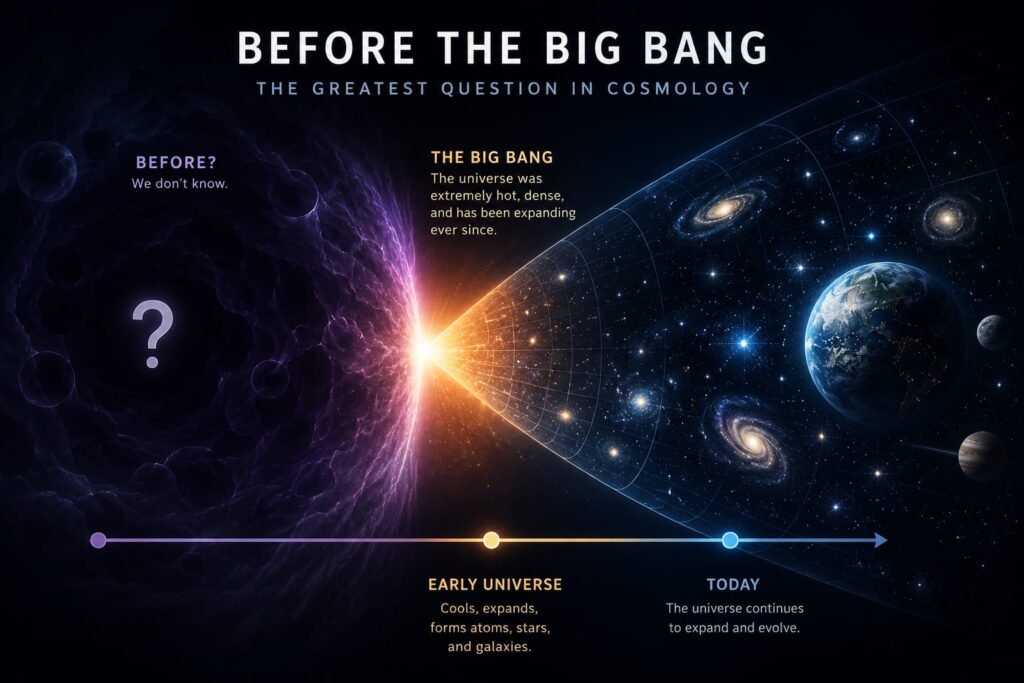
They did not observe the Big Bang itself. No telescope captured an explosion taking place at a particular location in space. The Big Bang is also not the name for an explosion into empty space. In modern cosmology, the term describes the early hot, dense state of the universe and its subsequent expansion and cooling.
Scientists instead reconstruct this history from evidence that can still be observed today.
Three observations are especially important: the expansion of the universe, the cosmic microwave background radiation, and the amounts of the lightest elements found throughout the cosmos. Each comes from a different physical process, yet all fit a consistent picture of a universe that was much hotter and denser in the past.
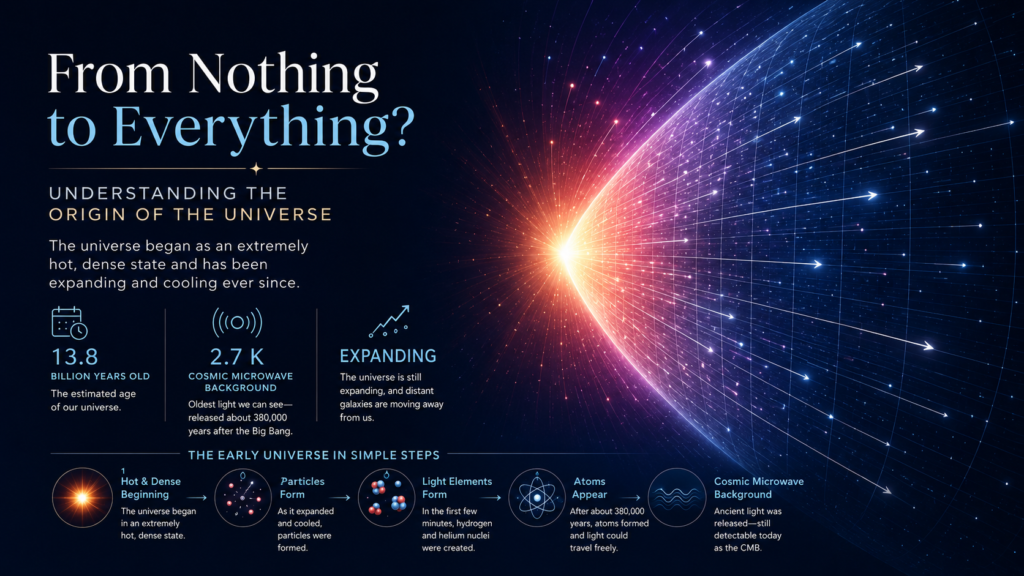
The most direct glimpse comes from the cosmic microwave background (CMB), the faint radiation that fills the sky and comes from a time when the universe was about 380,000 years old.
What Would We Expect If the Big Bang Model Were Correct?
The strength of a scientific model is not simply that it can explain something after the fact. A good model makes predictions that can be tested.
The hot Big Bang model describes a universe that has expanded and cooled. If that description is correct, scientists should be able to find traces of those earlier conditions.
That is exactly what astronomers have looked for.
The Universe Was Hotter and Denser in the Past
The expansion of the universe is an observed fact. Distant galaxies show systematic redshifts, meaning their light is shifted toward longer wavelengths as the universe expands. On large scales, more distant galaxies generally have larger recession velocities.
If the universe is expanding today, then it was smaller in the past. Going backward through the expansion history means matter and radiation were, on average, packed into a hotter and denser universe.
This does not mean scientists can simply rewind the universe like a video and see its beginning. It means observations of the present universe can be compared with physical models of how an expanding universe evolves.
That comparison produces testable predictions.
The Early Universe Should Have Left Traces
If the young universe was extremely hot and dense, some of its radiation and chemical products should have survived as observable evidence.
Scientists have found both.
The ancient radiation is now detected as the cosmic microwave background. The chemical evidence appears in the abundance of light elements such as hydrogen and helium.
These observations are important because they were not all discovered at once or with the same type of instrument. They provide independent ways to test the same broad picture of cosmic evolution.
Cosmic Microwave Background Radiation: A Direct Look at the Young Universe
The cosmic microwave background radiation, usually shortened to CMB, is the oldest light we can directly observe.
To understand why it matters, consider what the early universe was like.
It was filled with a hot plasma—a state of matter in which electrons and atomic nuclei were not yet bound together into ordinary atoms. Photons, the particles that make up light, constantly interacted with the free electrons.
As a result, light could not travel freely through the universe for long distances. The universe was effectively opaque.
As space expanded, the universe cooled.
Around 380,000 years after the beginning of its expansion, electrons could combine with atomic nuclei to form neutral atoms. With far fewer free electrons available to scatter photons, space became transparent and light could travel across the universe.
That light is what we observe today as the CMB.
Why Is the CMB Now Microwave Radiation?
The light released when the universe became transparent was much more energetic than the radiation we detect today.
The universe has continued to expand since then. As space expanded, the wavelengths of the traveling light stretched as well. This process is called cosmological redshift.
The result is that the ancient radiation now falls mainly in the microwave part of the electromagnetic spectrum.
Its average temperature today is about 2.7 kelvin, only a few degrees above absolute zero.
So the CMB is not radiation that was recently produced by stars or galaxies. It is a relic of a much younger universe.
How Was the CMB Discovered?
The CMB was discovered in the 1960s.
In 1964, radio astronomers Arno Penzias and Robert Wilson detected a persistent microwave signal while working with a sensitive antenna at Bell Telephone Laboratories.
The signal did not behave like an ordinary local source. It appeared to come from all directions.
This was significant because physicists had already predicted that a hot early universe should leave behind a background of cooled radiation. The discovery therefore provided a major observational confirmation of a prediction associated with the hot Big Bang model.
The CMB was later studied in much greater detail by spacecraft including NASA’s COBE and WMAP, and ESA’s Planck mission. These missions measured its spectrum and tiny variations across the sky with increasing precision.
The CMB Is More Than an Afterglow
The CMB would be important even if it were perfectly uniform.
But it is not.
When scientists measure it with enough precision, they find extremely small variations in temperature across the sky.
Tiny Variations Preserve Information About the Early Universe
These variations are incredibly small, but they correspond to slight differences in density in the young universe.
Some regions contained slightly more matter than others. Over enormous periods of time, gravity amplified these differences, contributing to the formation of the large-scale structures seen in the universe today.
COBE first measured the tiny variations in the CMB, while WMAP and Planck later mapped them with much greater detail.
This matters because scientists are not simply detecting an old glow. They are studying a measurable pattern that carries information about the physical conditions of the young universe.
What Does the CMB Tell Us?
The CMB provides evidence that the early universe was:
- hot;
- dense;
- filled with radiation and matter;
- remarkably uniform on large scales, but not perfectly uniform.
Its detailed pattern also allows scientists to test cosmological models and estimate important properties of the universe. NASA notes that CMB observations are among the key tools used to study the early universe.
This is also where scientists need to be careful about inflation.
Cosmic inflation is a proposed period of extremely rapid expansion in the very early universe. Certain features of the CMB are consistent with predictions made by inflationary models, but the physical mechanism responsible for inflation has not been established. NASA explicitly describes inflation as a hypothesis and notes that its underlying physical process remains unknown.
The evidence for the CMB itself is therefore much more firmly established than any particular explanation for what happened at the earliest stage of cosmic expansion.
The Expanding Universe Provides Another Clue
The CMB is not the only evidence.
Astronomers also observe that the universe is expanding.
What Does Redshift Tell Us?
When astronomers split the light from a distant galaxy into its component wavelengths, they can identify characteristic spectral lines produced by atoms.
In many distant galaxies, these lines are shifted toward the red end of the spectrum. This is called redshift.
On cosmic scales, the pattern of these redshifts shows that space is expanding. Edwin Hubble’s observations in the 1920s provided early observational evidence for this expansion, including the relationship between a galaxy’s distance and its recession velocity.
An expanding universe is not the same thing as galaxies flying away from a central point through otherwise empty space.
There is no known center of the cosmic expansion from which everything is moving outward.
Instead, on sufficiently large scales, the distances between galaxies increase as space itself expands.
Why Does Expansion Point to a Hotter Past?
Imagine tracking the expansion backward.
The average distances between galaxies become smaller. The matter and radiation in the universe become more concentrated, and the temperature rises.
That gives a broad sequence:
expanding today → smaller in the past → denser and hotter further back
This is one reason the discovery of cosmic expansion was so important to the development of the Big Bang model.
However, expansion alone is not enough to establish every detail of the early universe. Its significance becomes much stronger when it is considered alongside the CMB and the observed abundances of light elements.
The Lightest Elements Preserve Another Piece of the Evidence
The evidence for a hot early universe is also found in the chemical composition of the cosmos.
Hydrogen and Helium Were Produced Early
In the first few minutes of cosmic history, the universe was hot and dense enough for nuclear reactions involving protons and neutrons.
These reactions produced nuclei of hydrogen and helium, along with very small amounts of other light elements. This process is called Big Bang nucleosynthesis.
Much of the hydrogen and helium found in the universe today is consistent with this early origin.
Heavier elements such as carbon, oxygen, and iron were produced later through processes involving stars and stellar explosions.
Why Do the Amounts Matter?
Finding hydrogen and helium by itself would not be enough.
The important question is whether the predicted amounts of the light elements are consistent with what astronomers observe.
Calculations based on the conditions of the early universe predict a characteristic pattern of primordial light elements. Observations of ancient and relatively pristine material provide tests of those predictions.
The agreement is not perfect in every measurement, and some abundance questions remain active areas of research. But the overall pattern of primordial light elements is an important independent line of evidence for a hot, dense early universe. NASA identifies the abundance pattern of the lightest elements as one of the fundamental observations supporting the Big Bang model.
Three Independent Lines of Evidence
The case becomes clearer when the major observations are placed side by side.
| Evidence | What scientists observe | Why it matters |
|---|---|---|
| Cosmic expansion | Distant galaxies show systematic redshifts | Shows that the universe is expanding and has evolved over time |
| Cosmic microwave background | A nearly uniform microwave background with tiny temperature variations | Preserves information from the hot, dense universe about 380,000 years after expansion began |
| Light-element abundances | Primordial hydrogen, helium and traces of other light elements | Match the broad predictions of nuclear reactions in a hot early universe |
The strength of the evidence comes from this convergence.
These observations are not simply different measurements of one phenomenon. They involve different physical processes and different kinds of observations.
Yet they point toward the same broad history: the universe was once much hotter and denser, expanded and cooled, and changed over billions of years.
That is why scientists do not accept the Big Bang model merely because it is an old or popular idea. Its strength comes from its ability to account for multiple observations.
Can We Actually See the Big Bang?
This is one of the most common questions people have about the subject.
No, We Don’t See the Big Bang Itself
Scientists cannot observe the Big Bang as an explosion occurring at a particular place.
What telescopes and satellites detect are signals produced during later stages of the universe’s early evolution.
The CMB is the clearest example.
It comes from about 380,000 years after the beginning of cosmic expansion, when the universe became transparent to light. It does not show what happened at the earliest possible moment.
This is an important limitation.
When astronomers study the CMB, they are looking at the earliest universe that can be directly observed using electromagnetic light—not directly seeing “time zero.”
So What Are Scientists Actually Measuring?
They are measuring physical traces that survived from earlier conditions.
The CMB preserves information about the young universe.
The expansion of the universe records how cosmic distances have changed.
The abundance of light elements preserves evidence of nuclear reactions that occurred when the universe was only minutes old.
Taken together, these observations allow scientists to reconstruct parts of cosmic history without having directly observed the beginning itself.
Does This Mean Scientists Know Exactly What Happened at the Beginning?
No.
The evidence for a hot, expanding early universe is strong, but that is not the same as having a complete explanation of the universe’s ultimate origin.
There is a boundary between what observations tell us and what current theories attempt to explain.
Scientists have strong evidence that:
- the universe is expanding;
- it was much hotter and denser in the past;
- relic radiation from its early history can still be detected;
- light elements were produced under early-universe conditions.
But scientists do not have a confirmed observational account of what happened at the earliest possible moment.
The Big Bang model also does not establish that the universe came from “nothing.” That question goes beyond what the core observational evidence can currently answer.
Likewise, several ideas about what might have preceded the hot early universe have been proposed, but they should not be presented as established explanations.
What Do We Know—and What Don’t We Know?
Keeping these two categories separate is essential when talking about the origin of the universe.
What the Evidence Supports
Observations support a universe that:
- has been expanding;
- was much hotter and denser in the past;
- produced primordial light elements during its early evolution;
- released the radiation we now observe as the cosmic microwave background;
- has been evolving for approximately 13.8 billion years.
These conclusions are supported by multiple observations rather than a single discovery.
What Remains Uncertain
Scientists still do not have complete answers to questions such as:
- What physical process governed the earliest stage of cosmic expansion?
- What, if anything, can be meaningfully described as occurring “before” the Big Bang?
- How should our current theories be extended to describe the most extreme early conditions?
- What is the physical mechanism, if any, behind cosmic inflation?
Inflation remains an important area of research, but it should be distinguished from the more directly observed evidence for cosmic expansion and the CMB. NASA notes that while CMB observations are consistent with inflationary predictions, the physical process responsible for inflation remains unknown.
These unanswered questions do not overturn the evidence for the hot, expanding universe. They mark the boundary between what current observations establish and what cosmologists are still trying to understand.
Frequently Asked Questions
How do scientists know the Big Bang happened?
Scientists do not have a direct recording of the Big Bang. Instead, several independent observations support the model: the expansion of the universe, the cosmic microwave background radiation, and the observed abundance of primordial light elements.
What is the strongest evidence for the Big Bang?
The cosmic microwave background is one of the strongest and most direct pieces of evidence for a hot early universe. It is relic radiation released when the universe became transparent about 380,000 years after expansion began. Its observed properties closely match what is expected from a hot, dense early universe.
Is the cosmic microwave background the Big Bang?
No. The CMB is not the Big Bang itself. It is ancient light released roughly 380,000 years after the beginning of the universe’s expansion. We observe that radiation today after billions of years of cosmic expansion have stretched its wavelengths into the microwave range.
Was the Big Bang an explosion?
No. The Big Bang model does not describe an explosion from a central point into surrounding empty space. It describes the expansion and evolution of the universe itself. There is no known center from which the universe is expanding.
Do scientists know what happened at time zero?
No. Current observations provide strong evidence about the universe’s early hot and dense state, but they do not give scientists a complete description of an ultimate “time zero.” The physics of the earliest possible conditions remains an open research problem.