What was the Universe like before there were stars, galaxies, or even atoms?
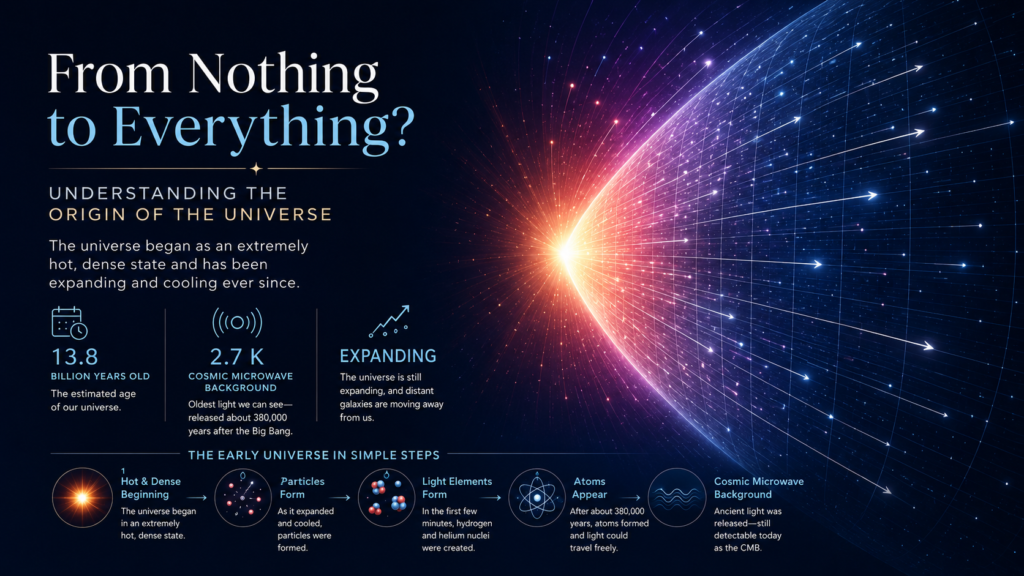
Today, the Universe is filled with billions of galaxies, stars, planets, gas clouds, and enormous structures spread across space. But about 13.8 billion years ago, the cosmos was in a much hotter, denser state. Over time, it expanded and cooled. Particles formed atomic nuclei, atoms eventually appeared, and gravity helped small differences in the early distribution of matter grow into stars, galaxies, and larger structures.
This is the basic story behind the universe timeline.
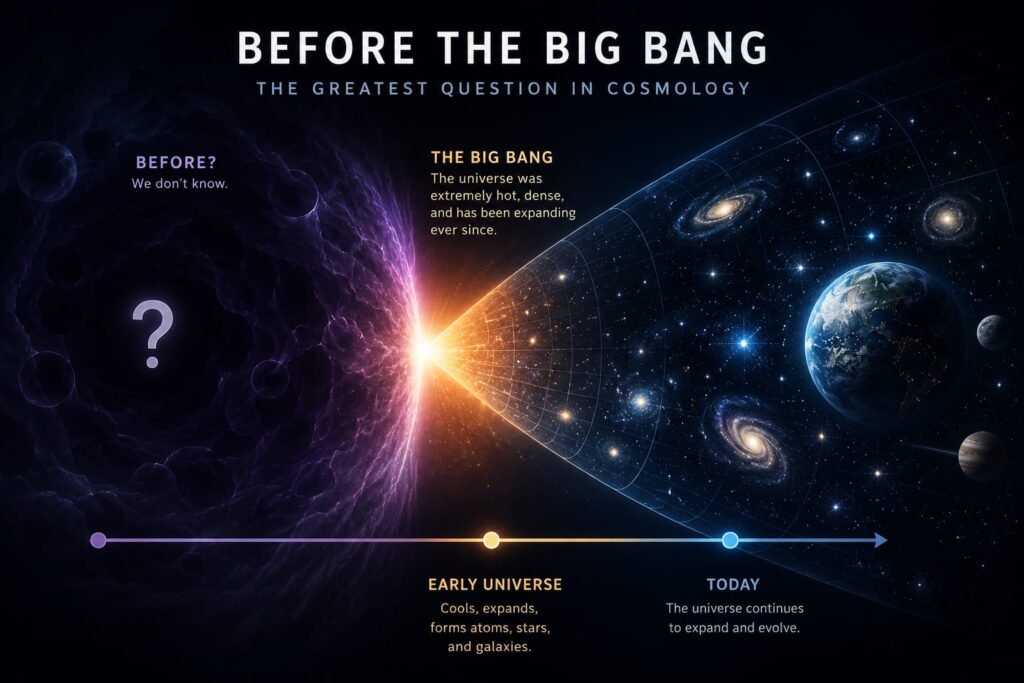
The Big Bang is not best understood as an explosion that happened at one point in empty space. It describes the early expansion and evolution of the Universe itself. We can reconstruct much of this history from observations such as the cosmic microwave background, the expansion of the Universe, ancient stars, and distant galaxies.
But there are limits to what we know. Scientists have strong evidence for many stages of cosmic history, while other details—such as exactly how inflation began or what happened at the earliest possible moment—remain unresolved.
Here is how the Universe changed from its hot early state into the cosmos we see today.
The Universe Timeline at a Glance
The entire history of the Universe covers an enormous span of time, but its major stages can be summarized simply:
- ~13.8 billion years ago: The Universe begins its hot, dense early expansion.
- First few minutes: Light atomic nuclei, mainly hydrogen and helium, form.
- ~380,000 years: Electrons combine with nuclei to form neutral atoms. The Universe becomes transparent, and the cosmic microwave background is released.
- After ~380,000 years: The Cosmic Dark Ages begin. There are no stars yet.
- Within the first few hundred million years: The first stars form, although their exact formation time is not known.
- Following the first stars: Early galaxies develop, and ultraviolet radiation contributes to the reionization of the intergalactic gas.
- Over billions of years: Galaxies grow and merge, stars form and die, and the large-scale cosmic web develops.
- ~4.6 billion years ago: The Solar System forms.
- Today: The Universe is about 13.8 billion years old and continues to expand. Its expansion is currently accelerating.
The further back we look, the more difficult direct observation becomes. We can observe the cosmic microwave background from about 380,000 years after the beginning of cosmic expansion, but we cannot directly see the first moments themselves.
The First Few Minutes of the Universe
The earliest Universe was extremely hot and dense. As it expanded, it cooled.
We cannot describe with confidence everything that happened at an absolute “time zero.” Current physics does not yet provide a complete description of the earliest possible state. Scientists also do not know what triggered the initial expansion.
One important idea used in modern cosmology is cosmic inflation—a proposed period of extremely rapid expansion very early in the Universe’s history. Inflation helps explain several observed properties of the Universe and may have amplified tiny early density fluctuations, but the physical mechanism responsible for inflation remains unknown.
From Particles to Atomic Nuclei
As the Universe cooled, elementary particles combined to form protons and neutrons.
Within the first few minutes, some of these protons and neutrons combined through Big Bang nucleosynthesis, producing the nuclei of light elements, mainly hydrogen and helium, along with small amounts of other light elements.
These were still only atomic nuclei, not complete atoms.
The Universe remained filled with a hot plasma in which free electrons interacted strongly with light. Photons could not travel very far without being scattered.
The ingredients for later stars and galaxies were present, but the Universe was still opaque.
380,000 Years Later: The Universe Becomes Transparent
The Universe continued expanding and cooling for hundreds of thousands of years.
Eventually, it became cool enough for electrons to remain attached to atomic nuclei.
When the First Atoms Formed
At roughly 380,000 years, the temperature had fallen to around 3,000 K.
Electrons could combine with protons and other nuclei to form neutral atoms, mostly hydrogen. With far fewer free electrons available to scatter photons, light could finally travel freely across space.
This transition is often called recombination.
The name can sound slightly confusing because the early Universe was forming neutral atoms for the first time after its plasma phase. What matters is that the Universe changed from an opaque plasma into a transparent one.
And the light released during this transition is still reaching us today.
What Is Microwave Background Radiation?
The cosmic microwave background, or CMB, is the oldest light we can directly observe.
It was released when the Universe became transparent about 380,000 years after the beginning of its expansion. Since then, the continued expansion of space has stretched the wavelengths of this radiation. Today, we detect it primarily at microwave wavelengths, with an average temperature of about 2.7 K above absolute zero.
A useful way to think about the CMB is as a baby picture of the Universe.
It does not show the Universe as it looked when the first stars existed. Instead, it shows the cosmos much earlier, before stars and galaxies had formed.
Why Is the Cosmic Microwave Background Important?
The CMB is not perfectly uniform.
It contains extremely small temperature variations—about one part in 100,000. These variations correspond to small differences in the density of matter in the early Universe.
Those differences mattered because gravity can make denser regions attract more matter.
Over hundreds of millions and billions of years, these small variations grew into increasingly large structures.
This provides an important link in the universe timeline:
early density differences → gravity → stars and galaxies → large-scale cosmic structure
The CMB therefore gives scientists a way to connect the young Universe with the structures we observe today.
The Dark Ages of the Universe
The Universe was transparent after the CMB was released, but it was not yet filled with stars.
This period is known as the Cosmic Dark Ages.
A Universe Without Stars
After recombination, much of the ordinary matter was neutral hydrogen and helium.
There were no stars producing widespread starlight, so the Universe would have looked very different from the night sky we see today.
But the cosmos was far from inactive.
Matter was gradually gathering into denser regions under gravity. Dark matter also contributed to this process through its gravitational influence. These growing structures provided the environments in which the first stars could eventually form.
How Gravity Prepared the Way for the First Stars
The early Universe contained small differences in density.
A slightly denser region had a little more gravitational attraction than its surroundings. As matter gathered there, the region became denser still.
Over time, clouds of gas collapsed into increasingly compact structures.
Eventually, some of these clouds became hot and dense enough in their centers for nuclear fusion to begin.
The first stars had arrived.
The First Stars Ignite
The exact birth date of the first stars is still unknown.
Scientists know that they formed after recombination, about 380,000 years after the beginning of cosmic expansion, and before the oldest galaxies we can observe. Current observations place the emergence of the first stars somewhere within the first few hundred million years.
When Did the First Stars Form?
The first stars formed from gas dominated by hydrogen and helium.
They were different from stars such as our Sun because the early Universe had not yet been enriched with the heavier elements produced by earlier generations of stars.
Scientists have models for what these first stars may have been like, but their exact properties remain uncertain. We have not directly observed an individual first-generation star.
This is an important distinction:
Scientists have strong evidence that the first stars existed, but many details about their individual properties are still theoretical.
Why the First Stars Changed the Universe
The first stars changed their surroundings in several ways.
They produced enormous amounts of radiation and created heavier elements through nuclear fusion. When massive stars died, some of these elements were returned to space.
That enriched material later became part of new generations of stars and, eventually, planetary systems.
The first stars also emitted ultraviolet radiation that affected the neutral hydrogen surrounding them.
This helped drive one of the major transitions in early cosmic history: reionization.
The First Galaxies and the Growing Cosmic Web
Stars did not remain isolated.
Gravity continued bringing matter together, allowing stars, gas, and dark matter to become part of larger structures.
How Galaxies Began to Grow
The earliest galaxies were probably much smaller than many galaxies we see today.
Over time, galaxies grew through star formation, the accumulation of gas and matter, and mergers with other galaxies.
Galaxy formation was therefore not a single event. It was a continuing process.
Astronomers can study this history by observing galaxies at different distances. Because light takes time to travel, a very distant galaxy is seen as it was much earlier in cosmic history.
This allows telescopes to sample different stages of galaxy evolution.
The Cosmic Web Takes Shape
On the largest scales, matter is not spread evenly throughout the Universe.
Galaxies are arranged along enormous structures called filaments, which connect denser regions containing galaxy groups and clusters. Between these structures are huge regions known as cosmic voids.
Together, these structures form the cosmic web.
The pattern seen today can be traced back to the small variations in density present in the early Universe. Gravity gradually amplified those variations as the Universe evolved.
Reionization: The Universe Changes Again
The first stars and galaxies brought light into the previously dark Universe, but their radiation also changed the gas between galaxies.
What Was Cosmic Reionization?
Ultraviolet radiation from early stars and galaxies could remove electrons from neutral hydrogen atoms.
This process is called ionization.
As more stars and galaxies formed, regions of ionized gas grew and eventually spread through much of the intergalactic medium.
This extended period is called cosmic reionization.
Scientists do not describe reionization as a single instant. It was a gradual transition that took place over a substantial period of cosmic history.
How Early Stars and Galaxies Changed Their Surroundings
The first stars were therefore important for more than producing visible light.
Their radiation changed the physical state of the surrounding gas. Their lives and deaths also affected the chemical composition of the Universe.
As later generations of stars formed from increasingly enriched material, the ingredients available for planets and other complex objects became more diverse.
The Universe was becoming more structured and chemically complex.
Billions of Years of Cosmic Evolution
After the first stars and galaxies appeared, cosmic evolution continued for billions of years.
There was no single moment when the modern Universe suddenly appeared.
Galaxies continued forming stars, interacting with one another, merging, and changing their structures.
Galaxies Grow and Transform
Stars are born, evolve, and eventually die.
Some massive stars end their lives in powerful explosions, releasing elements into surrounding space. Those elements can later become part of new stars and planetary systems.
Galaxies can also merge.
A small galaxy can be absorbed by a larger one, while major galaxy mergers can dramatically change their shapes and trigger periods of increased star formation.
Over billions of years, these processes helped produce the wide variety of galaxies we observe today.
The cosmic web also continued evolving as gravity pulled matter into increasingly dense structures.
The Expansion of the Universe Accelerates
The Universe has been expanding throughout its history.
For a long period, gravity from matter worked against that expansion. But observations of distant Type Ia supernovae in the late 1990s showed that the expansion is now accelerating.
Scientists use the term dark energy for whatever is responsible for this accelerated expansion in the standard cosmological picture.
What dark energy actually is remains unknown.
Several explanations have been proposed, including vacuum energy and modifications to our understanding of gravity, but none has been established as the definitive answer.
For the universe timeline, the important point is that the expansion that began in the early Universe has not stopped—and its rate of expansion is currently increasing.
About 4.6 Billion Years Ago: The Solar System Forms
By this point, the Universe was already roughly nine billion years old.
Many generations of stars had formed and died, enriching galaxies with heavier elements.
Then, in one region of the Milky Way, a new planetary system began to form.
The Birth of the Sun
Our Solar System formed about 4.6 billion years ago from a collapsing cloud of gas and dust.
As gravity pulled the material inward, the cloud flattened into a rotating disk. Most of the material collected near the center, where the Sun eventually formed. The remaining material in the disk gradually came together to form planets and smaller bodies.
The Sun contains about 99.8% of the mass of the Solar System.
Earth Joins the Cosmic Timeline
Earth formed as part of this same process.
That means Earth is not a remnant from the beginning of the Universe. It formed billions of years later from material that had already been processed through earlier generations of stars.
The broad sequence is:
early Universe → stars → heavier elements → galaxies → later generations of stars → Solar System → Earth
Our planet is a relatively recent chapter in a much older cosmic history.
The Universe Today
A 13.8-Billion-Year-Old Universe
The Universe is approximately 13.8 billion years old. This estimate comes from several lines of evidence, including measurements of cosmic expansion, observations of the oldest stars, and detailed studies of the cosmic microwave background.
Today, the Universe contains galaxies, stars, planetary systems, galaxy clusters, enormous cosmic filaments, and vast cosmic voids.
It also contains dark matter, which we infer from its gravitational effects, and dark energy, which is associated with the accelerated expansion of the Universe.
The Universe is not static.
Stars are still forming and dying. Galaxies continue to interact. New planetary systems can form around young stars.
Cosmic evolution is still happening.
Why Looking Far Away Means Looking Back in Time
Light travels at a finite speed.
So when astronomers observe a galaxy one billion light-years away, they see light that left that galaxy roughly one billion years ago.
A galaxy ten billion light-years away is seen at a much earlier stage of cosmic history.
This is one of the most useful ideas in observational astronomy.
A telescope is not simply looking across space. It is also looking backward in time.
That is why distant galaxies can help scientists reconstruct how the Universe changed over billions of years.
How Scientists Reconstructed the Universe Timeline
The universe timeline is not based on a single observation.
Scientists compare evidence from several independent sources and test whether their models can explain what those observations show.
Evidence From the Cosmic Microwave Background
The CMB provides our oldest direct view of the Universe through light.
It shows the cosmos about 380,000 years after the beginning of its expansion, when the Universe was still extremely young compared with its current age.
Its tiny temperature variations contain information about the early distribution of matter and radiation. These variations are closely connected to the later formation of cosmic structures.
This makes the CMB one of the strongest foundations of modern cosmology.
Evidence From Cosmic Expansion
Astronomers observe systematic redshifts in the light from distant galaxies.
Combined with distance measurements, these observations show that the Universe is expanding.
Measurements of this expansion, together with other observations, help scientists estimate the age and history of the cosmos.
Evidence From Ancient Stars and Galaxies
The oldest stars provide another way to test the timeline.
Distant galaxies provide an even more direct look into earlier cosmic eras because their light has taken billions of years to reach us.
Telescopes such as the James Webb Space Telescope have detected galaxies from very early periods of cosmic history, allowing astronomers to test models of how the first galaxies formed and evolved.
Evidence From the Elements
The chemical composition of the Universe also contains clues about its history.
Hydrogen and helium were produced in large quantities during the early Universe, while heavier elements were produced later through stellar processes.
The observed abundance of these elements provides an additional test of models describing both the early Universe and the evolution of stars.
No single piece of evidence explains the entire timeline.
The strength of modern cosmology comes from the fact that different observations can be compared within the same overall framework.
The Universe Timeline in One Simple Story
The history of the Universe can be reduced to a series of major transitions:
Hot, dense early Universe
↓
Particles and light atomic nuclei form
↓
Atoms form
↓
Cosmic microwave background is released
↓
Dark Ages
↓
First stars
↓
First galaxies
↓
Reionization
↓
Galaxies, clusters and the cosmic web develop
↓
Solar System forms
↓
Universe today
Each stage follows from physical processes that operated over different timescales.
The early Universe provided the conditions and small density variations.
Expansion cooled the cosmos.
Gravity gathered matter.
Stars produced light and heavier elements.
Galaxies grew and interacted.
Eventually, planetary systems formed around later generations of stars.
That is the basic story behind how the Universe changed from its early state into the cosmos we observe today.
Frequently Asked Questions About the Universe Timeline
How old is the Universe?
The Universe is approximately 13.8 billion years old. This estimate is supported by observations including the cosmic microwave background, cosmic expansion, and the ages of ancient stars.
What happened about 380,000 years after the Big Bang?
The Universe had cooled enough for electrons to combine with nuclei and form neutral atoms. With fewer free electrons to scatter photons, light could travel freely through space. That ancient radiation is observed today as the cosmic microwave background.
What is microwave background radiation?
Microwave background radiation, more commonly called the cosmic microwave background (CMB), is the oldest light we can directly observe. It was released when the early Universe became transparent and has since been stretched into microwave wavelengths by cosmic expansion.
When did the first stars form?
The exact date is unknown. Scientists know that the first stars formed after recombination and before the oldest galaxies we can observe. Evidence indicates that they appeared within the first few hundred million years of cosmic history.
When did the Solar System form?
The Solar System formed about 4.6 billion years ago from a collapsing cloud of gas and dust.
Is the Universe still expanding?
Yes. The Universe continues to expand, and observations show that its expansion is currently accelerating. Scientists associate this acceleration with dark energy, although the physical nature of dark energy remains unknown.
Do scientists know exactly what happened at the beginning of the Universe?
No.
The Big Bang model successfully describes the expansion and evolution of the early Universe and is strongly supported by observations. But scientists do not yet have a complete theory describing the earliest possible moment, and they do not know exactly what triggered the initial expansion.
Ideas such as cosmic inflation address some questions about the very early Universe, but inflation itself remains a model whose underlying physical mechanism is not fully understood.
Conclusion: From the Big Bang to the Cosmos We See Today
The Universe we see today did not appear fully formed.
Its history is a sequence of physical changes spread across roughly 13.8 billion years. The early Universe expanded and cooled. Light atomic nuclei formed within minutes. Hundreds of thousands of years later, atoms formed and the Universe became transparent, leaving behind the cosmic microwave background.
Then came the Dark Ages.
Gravity gradually gathered matter into denser regions until the first stars formed. Those stars changed their surroundings, produced heavier elements, and helped drive the transition toward a Universe filled with galaxies. Over billions of years, galaxies grew, merged, and became part of the large-scale cosmic web.
Much later, about 4.6 billion years ago, our Solar System formed.
We can reconstruct much of this history because the Universe has left evidence behind—in the CMB, in the expansion of space, in ancient stars and galaxies, and in the elements around us.
But the story is not complete.
We still do not know exactly what happened at the earliest possible moment, what powered inflation, or what dark energy fundamentally is.
Those unanswered questions are part of what makes the Universe timeline an ongoing scientific investigation.
And one of the biggest remaining questions takes us back to the beginning of cosmic structure:
What were the first stars actually like, and how did they transform the young Universe?