Before there were stars, the universe was a very different place.
There were no galaxies shining across the sky, no planets orbiting suns, and no familiar starlight. The young universe was filled mainly with hydrogen and helium gas, along with dark matter and radiation. Over time, gravity pulled matter into denser regions, allowing some clouds of gas to collapse.
Eventually, their centers became hot and dense enough for nuclear fusion to begin.
That is how the first stars are thought to have formed.
Scientists do not know the exact moment when the first star appeared, but evidence and theoretical models place the first generation within the first few hundred million years of cosmic history.
The story is not simply “the Big Bang happened, then stars appeared.” The universe had to expand and cool, atoms had to form, matter had to gather under gravity, and gas clouds had to collapse before the first stars could ignite.
What Was the Universe Like Before the First Stars?
To understand how the first stars formed, it helps to start with what was available to make them.
The universe did not begin with the rich mixture of elements found in today’s stars. Its early chemical inventory was dominated by hydrogen and helium, with a tiny amount of lithium. Heavier elements such as carbon, oxygen and iron became abundant only after stars began making them.
A Universe Filled Mostly With Hydrogen and Helium
Around 380,000 years after the universe began expanding, it had cooled enough for electrons to combine with atomic nuclei and form neutral atoms. Hydrogen and helium made up most of the ordinary matter available at this stage.
This was important for the first stars because there were no earlier generations of stars to enrich the gas with heavier elements.
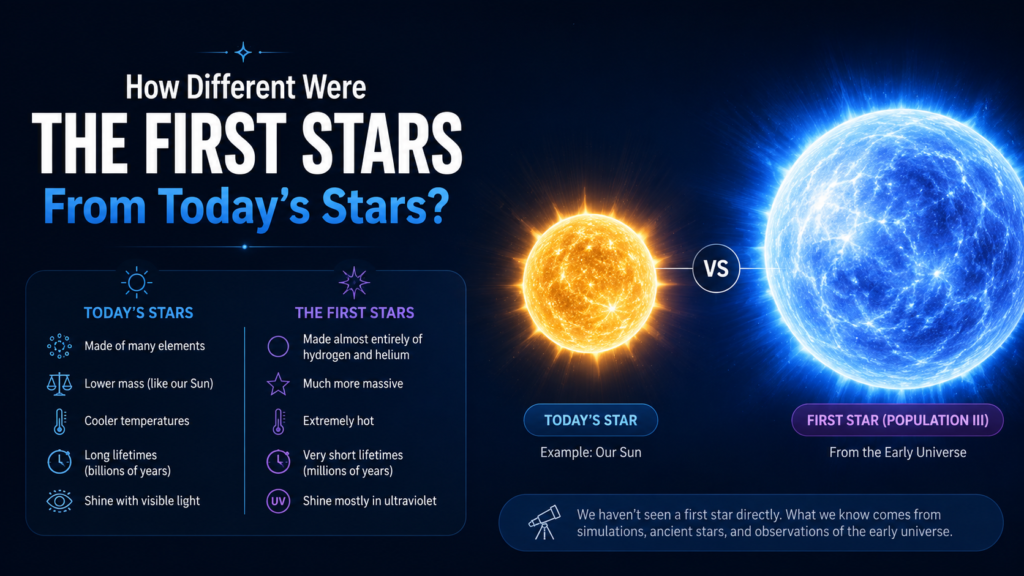
The first generation is commonly called Population III, or Pop III, stars. They are expected to have formed from nearly pristine material left over from the early universe.
The term “metal” has a special meaning in astronomy. It refers to any element heavier than helium, not just metals such as iron.
So when astronomers describe the first stars as metal-free, they mean that they should have contained essentially no elements heavier than helium.
The Cosmic Dark Ages
The young universe then entered a period known as the cosmic dark ages.
“Dark” does not mean that space was empty.
Hydrogen and helium gas were present, dark matter was providing gravitational structure, and radiation filled the universe. What was missing was a population of stars producing their own light.
The cosmic microwave background, or CMB, gives scientists a snapshot of the universe when it was about 380,000 years old. It shows that the early universe was remarkably smooth overall, with tiny variations in density and temperature. Those small differences provided the starting conditions for the growth of later cosmic structures.
From there, gravity gradually amplified those differences.
The dark ages would not last forever.
How Did Gravity Gather the Material for the First Stars?
The first stars did not form randomly from gas spread evenly through space.
Gravity had to bring matter together.
Dark Matter Helped Build the First Structures
Dark matter cannot be seen directly because it does not interact with light in the same way ordinary matter does. Scientists infer its presence from its gravitational effects.
In the early universe, dark matter gathered into increasingly dense structures. These structures created gravitational wells that helped attract ordinary matter, including hydrogen and helium gas.
This does not mean dark matter directly turned into stars or created them by itself.
A simpler way to picture the process is:
Dark matter structures → stronger gravitational wells → gas gathers → dense clouds develop → stars can form
This gravitational framework was important because ordinary gas needed sufficiently dense environments before it could begin collapsing into stars.
Gravity Pulled Gas Into Denser Regions
Once gas collected in these growing structures, gravity continued pulling material inward.
As a region became denser, more matter was concentrated into a smaller space. That increased the gravitational attraction within the region and allowed still more gas to gather.
The process was gradual.
There was no single moment when the universe suddenly filled with stars. Instead, increasingly dense regions developed until some gas clouds reached the conditions required for gravitational collapse.
That was the beginning of star formation.
How Did a Gas Cloud Become the First Star?
This is the central part of the story.
A star begins as a cloud of gas, but gravity alone is not enough to explain the entire process. The cloud must become dense and hot enough for the physical conditions inside a stellar core to develop.
Gas Clouds Began to Collapse
When gravity overcame the forces supporting a sufficiently dense region of gas, the material began collapsing inward.
As the cloud contracted, its density increased. Particles collided more frequently, and the central region became hotter.
The energy released by gravitational contraction was converted into heat.
This process continued as material accumulated toward the center.
Think of it as a cosmic squeeze: gravity kept pulling the gas inward, while the collapsing material became increasingly compressed and heated.
Eventually, a dense central object developed.
The First Protostars
That developing object is called a protostar.
A protostar is a young stellar object that has not yet reached the stage where sustained hydrogen fusion provides its main energy source.
The first protostars formed under unusual conditions because their gas contained almost none of the heavier elements found in modern star-forming clouds.
That difference affected how efficiently the gas could cool and how the collapsing material could break apart.
Computer simulations are therefore an important part of studying the first stars. Scientists can model how primordial gas behaves under the physical conditions expected in the early universe.
When Did Nuclear Fusion Begin?
As the protostar continued to contract, its central temperature and density increased.
Eventually, the core could become hot and dense enough for nuclear fusion to begin.
Nuclear fusion is the process in which light atomic nuclei combine to form heavier nuclei, releasing energy. In ordinary stars, hydrogen fusion provides the energy that allows the star to shine.
Once sustained hydrogen fusion began, the object had become a true star.
The basic process can be summarized simply:
Gas cloud → gravitational collapse → protostar → hotter, denser core → nuclear fusion → star
That transition marked one of the most important changes in the history of the universe.
Why Were the First Stars Different From Stars Today?
The first stars formed before the universe had been chemically enriched by earlier generations of stars.
That makes them fundamentally interesting—and difficult to study.
They Had Almost No Heavy Elements
Modern stars contain elements that did not exist in significant amounts in the earliest stages of cosmic history.
The first stars are expected to have formed almost entirely from hydrogen and helium, with only a tiny amount of lithium.
Heavy elements can help gas clouds cool, allowing them to fragment into smaller pieces during star formation.
The primordial gas from which the first stars formed lacked this source of cooling.
As a result, the collapse and fragmentation of the first star-forming clouds were probably different from what happens in many modern star-forming regions.
This is one reason scientists expect the first stellar population to have differed from the stars surrounding us today.
The First Stars May Have Been Massive
This is where the evidence becomes less certain.
Scientists have not directly observed a confirmed Population III star, so they cannot simply measure the mass of one and settle the question.
Instead, researchers use computer simulations and indirect evidence.
Many models suggest that the first stars were likely more massive than typical stars forming today. NASA’s current overview notes estimates that can range from roughly 10 to 300 times the mass of the Sun, while also emphasizing that the exact properties of these stars remain uncertain.
Older models sometimes predicted far more extreme masses, showing why it is better to describe the mass of the first stars as a prediction of models, not an established fact.
They Were Probably Short-Lived
If many of the first stars were massive, they would have consumed their nuclear fuel rapidly compared with smaller stars.
That means many may have lived for only a relatively short time.
But a short life does not mean an unimportant one.
Their radiation would have affected the surrounding gas, while their eventual deaths could have returned newly created heavy elements to space.
Those elements later became available to new generations of stars and other cosmic structures.
The details of how this happened belong to the next stages of cosmic evolution, but the first stars began the process.
When Did the First Stars Form?
There is no scientifically established date for the birth of the very first star.
Astronomers know that it must have happened after the universe became transparent and atoms formed, about 380,000 years after the beginning of cosmic expansion. They also know that galaxies already existed less than 400 million years later.
This places the first stars somewhere within that broad interval.
A commonly used description is that they formed a few hundred million years after the Big Bang, but the exact timing remains uncertain.
A simplified timeline looks like this:
About 13.8 billion years ago
The universe begins its hot, dense expansion described by the Big Bang model.
About 380,000 years later
Atoms form and the universe becomes transparent. The CMB is released.
Cosmic dark ages
Hydrogen and helium gas fill the universe while gravitational structures continue developing.
Within the first few hundred million years
The first stars are thought to ignite.
Afterward
Stars and growing structures contribute to the emergence of the first galaxies and the increasingly complex universe observed today.
The important point is that star formation was a process, not a single event that happened everywhere at once.
How Do Scientists Know the First Stars Formed?
This is one of the most interesting parts of the story because astronomers have not simply taken a photograph of the first stars.
Instead, they reconstruct their history from several kinds of evidence.
Evidence From the Early Universe
Telescopes such as Hubble and Webb can observe extremely distant galaxies. Because light takes time to travel, looking farther into space also means looking farther back in cosmic history.
Webb has already observed galaxies from less than 400 million years after the Big Bang, providing direct evidence that substantial stellar and galactic activity was already underway surprisingly early.
These observations do not show us the very first star itself, but they help constrain when stars and galaxies were already present.
Evidence From Ancient Stars
Another clue comes from stars that formed from chemically primitive material.
Some extremely old stars contain very small amounts of heavy elements. Their chemical composition preserves information about the material available during earlier stages of cosmic history.
If a star formed from gas enriched by only a small number of previous stars, its chemistry can provide clues about those earlier generations.
This is a little like reading a historical record from the chemical composition of a star.
Computer Simulations Fill in the Gaps
Scientists also use numerical simulations to model the formation of the first stars.
They begin with the physical conditions expected in the early universe and calculate how dark matter and ordinary gas evolve under gravity.
The simulations can explore questions that observations alone cannot yet answer:
How did primordial gas collapse?
How large could the first stars become?
How did the absence of heavy elements affect their formation?
How many stars could form inside an early structure?
The results are not photographs of the past. They are testable predictions based on known physics and assumptions that can be compared with observations.
That distinction matters.
Some parts of the first-star story are directly observed; other parts are reconstructed from theory, simulations and indirect evidence.
Have Scientists Seen a First-Generation Star?
Not yet.
Astronomers have not confirmed the direct observation of an individual Population III star.
NASA notes that even powerful observatories have not detected these stars directly. Their expected properties are instead inferred from the chemistry of the early universe, observations of ancient objects and theoretical models of star formation.
This does not mean scientists know nothing about them.
The composition of the material from which they formed is strongly constrained by early-universe physics. Their exact masses, numbers, lifetimes and other properties are much less certain.
That difference between what is well established and what is still modeled is important when discussing the first stars.
Why Were the First Stars So Important?
The first stars changed more than the appearance of the universe.
They helped move the cosmos into a new stage of evolution.
They Brought Starlight Into the Dark Ages
Before the first stars, there were no stellar sources producing intense ultraviolet and visible light.
Once the first stars appeared, their radiation began interacting with the surrounding hydrogen gas.
Their light helped end the long cosmic dark ages and contributed to the transition toward the era of reionization.
This process was not instantaneous, and it was not caused by one star. It developed as populations of early luminous objects appeared and their combined radiation affected increasingly large regions of space.
They Began Enriching the Universe With Heavy Elements
The first stars also started changing the universe’s chemistry.
Stars can manufacture heavier elements through nuclear reactions. When massive stars die, some of their material can be returned to surrounding space.
This allowed later generations of stars to form from gas containing elements that the first stars did not have.
That chemical enrichment eventually became important for the formation of planets and the complex environments found around later generations of stars.
They Helped Set the Stage for Galaxies
The first stars formed within growing cosmic structures rather than appearing as isolated lights across an otherwise unchanged universe.
As structures continued to grow and merge, stars became part of larger stellar systems and eventually galaxies.
The broad sequence is:
First stars → growing stellar populations → early galaxies → increasingly complex galaxies
The Milky Way came much later.
So the first stars were not the final product of cosmic evolution. They were one of the steps that made later cosmic structures possible.
What Do Scientists Still Not Know About the First Stars?
Despite decades of research, important questions remain open.
Scientists still do not know exactly when the very first star formed or precisely how the first population was distributed by mass.
There is also uncertainty about how many first-generation stars formed, how their birth clouds fragmented, how long individual stars survived, and exactly how strongly their radiation affected the surrounding universe.
Perhaps the biggest observational challenge is finding unmistakable evidence of a truly metal-free Population III star.
Future observations may narrow these uncertainties.
For now, the scientific picture has two layers.
The first is relatively well established: the early universe contained mostly hydrogen and helium; gravity caused structure to grow; gas accumulated in dense regions; and stars eventually formed.
The second is still being investigated: the exact properties of the first stars and the detailed sequence of their formation and evolution.
Keeping those two layers separate is essential.
Conclusion: The First Stars Changed the Young Universe
The first stars did not appear immediately after the universe began expanding.
The universe first had to cool enough for atoms to form. During the following dark ages, gravity gradually gathered matter into increasingly dense structures. Hydrogen and helium gas collected within those structures, and some clouds eventually became unstable and collapsed.
As the gas contracted, its central region became denser and hotter.
Protostars developed.
Eventually, some cores became hot and dense enough for hydrogen fusion to begin.
The first stars had arrived.
Scientists are confident about this broad sequence because it follows established physics and is supported by observations of the early universe, ancient stars, distant galaxies and the cosmic microwave background. But many details remain uncertain, especially the exact properties and timing of the first stellar generation.
The importance of the first stars goes far beyond their light. They began changing the chemistry and radiation environment of the young universe and helped set the stage for the galaxies that followed.
The universe had its first stars. The next question is what those stars were actually like.
Frequently Asked Questions
How did the first stars form?
The first stars formed when gravity gathered primordial hydrogen and helium gas into dense regions. Some clouds collapsed, forming protostars. As their centers became hotter and denser, hydrogen fusion eventually began, producing the first stars.
When did the first stars form?
Scientists do not know the exact date. Current evidence indicates that the first stars formed sometime after atoms appeared, about 380,000 years after the universe began expanding, and before the earliest known galaxies observed less than 400 million years later. They are generally thought to have formed within the first few hundred million years.
What were the first stars made of?
The first stars are expected to have been made almost entirely of hydrogen and helium, with tiny amounts of lithium. They should have contained essentially none of the heavier elements produced by earlier stars.
Were the first stars bigger than the Sun?
Many theoretical models suggest that the first stars were generally more massive than typical stars today. However, scientists have not directly observed a confirmed Population III star, so their exact mass distribution remains uncertain.
Have scientists directly seen the first stars?
No confirmed Population III star has yet been directly observed. Astronomers instead study distant early galaxies, ancient chemically primitive stars, observations of the early universe and computer simulations to reconstruct their history.
Why were the first stars important?
They introduced powerful sources of starlight into the young universe, contributed to the transformation of the surrounding hydrogen gas and began the process of enriching the universe with heavier elements. Later generations of stars and cosmic structures developed from this increasingly enriched environment.