Cosmic Inflation: How the Early Universe Expanded in a Fraction of a Second
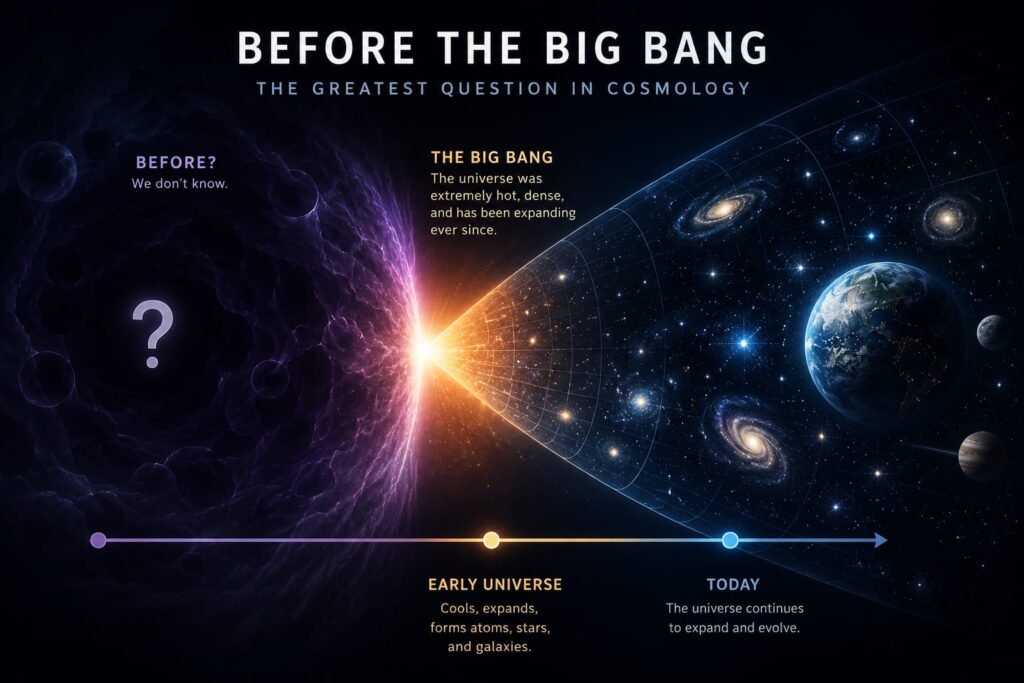
A second after the Big Bang, the universe was already expanding, cooling, and filled with an extremely hot mixture of particles and radiation. But if we move further back into cosmic history, we encounter an even more extreme possibility: cosmic inflation.
Inflation is a theoretical framework proposing that, during an extraordinarily early phase of the universe, space expanded at an enormous rate for a very short time. NASA describes this period as occurring roughly 13.8 billion years ago, lasting only a fraction of a second.
But inflation is not simply the Big Bang happening faster.
The Big Bang model describes the universe evolving from an extremely hot, dense early state as it expanded and cooled. Inflation is a proposed earlier phase that may explain why that early universe had some of the remarkable properties we observe today.
Scientists have not directly observed inflation itself. They also do not yet know what caused it or what, if anything, came before it. What makes inflation important is that it offers a possible explanation for several observations, including the universe’s large-scale uniformity, its near-flat geometry, and the tiny fluctuations that eventually helped cosmic structure form.
So, what exactly was cosmic inflation, and why do scientists take the idea seriously?
What Is Cosmic Inflation?
Inflation in simple terms
Cosmic inflation is a proposed period of extremely rapid expansion in the very early universe.
The key idea is that it was space itself that expanded.
Imagine drawing several dots on a rubber sheet. If the sheet stretches, every dot becomes farther from the others. The dots do not necessarily have to race across the sheet. Instead, the distance between them increases because the sheet is expanding.
Inflation is somewhat similar in concept.
The universe was not expanding into some empty space outside it. Rather, the distances within space were increasing extremely rapidly.
The analogy has limits, of course. The universe is not literally a rubber sheet, and inflation was not an explosion from a central point into surrounding space.
That distinction is important because the Big Bang should not be pictured as a conventional explosion.
How fast was inflation?
The proposed expansion was enormous.
ESA describes inflationary models in which the universe could have increased in size by a factor of roughly 10³⁰ during the inflationary period. That is a model-dependent description of the enormous expansion involved, not a measurement of a specific starting and ending size.
NASA describes inflation as an expansion faster than the speed of light.
That does not mean matter was locally travelling through space faster than light.
According to relativity, an object cannot locally move through space faster than light. But the expansion of space itself can cause sufficiently distant regions to become separated at a rate greater than the speed of light.
So inflation does not require breaking Einstein’s speed limit.
When Did Cosmic Inflation Happen?
Inflation is placed extremely early in the universe’s history, long before atoms, stars, or galaxies existed.
A simplified picture is:
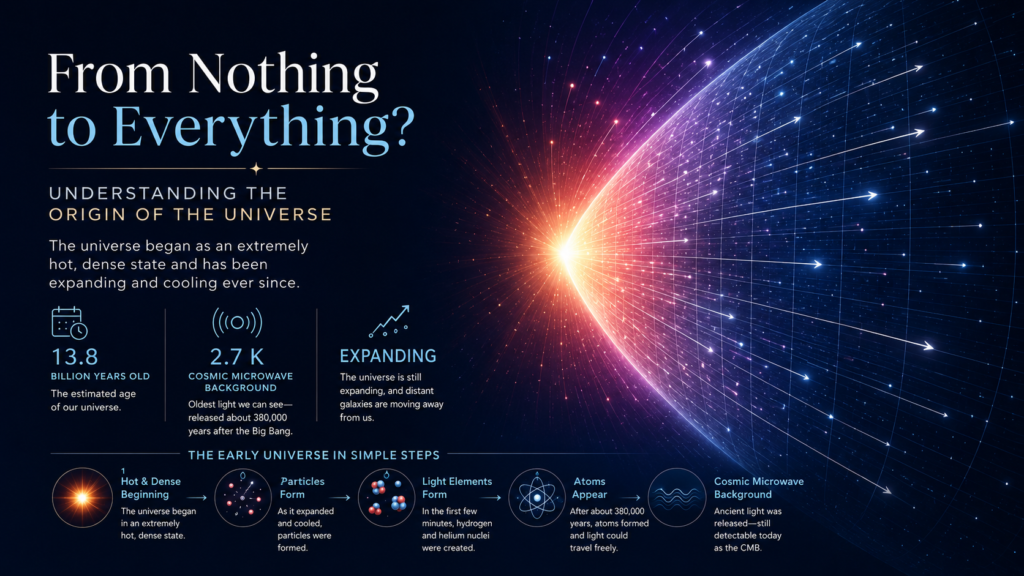
Inflation → hot early universe → particles → ~1 second → first few minutes → atoms → stars → galaxies
However, this should not be treated as a perfectly measured timeline.
Scientists do not know the exact moment inflation began or ended, and different inflationary models describe its details differently. NASA describes inflation as a very early period of rapid expansion and notes that scientists still do not know what powered it or what came before it.
This is also why it is useful to distinguish inflation from the broader Big Bang model.
The later hot, expanding universe is supported by several independent observations. Inflation is a proposed early component of that broader picture that attempts to explain why the universe began its hot expansion with the properties we observe.
Why Do Scientists Think Inflation Was Needed?
Inflation became influential because it offers possible solutions to several puzzles in cosmology.
One of the most important is called the horizon problem.
The horizon problem: Why is the universe so uniform?
The cosmic microwave background, or CMB, is the oldest light we can directly observe. It comes from about 380,000 years after the beginning of the hot Big Bang phase and is remarkably uniform across the sky, although it contains tiny temperature variations.
That uniformity raises a question.
How did regions that are extremely far apart today end up with such similar conditions?
In a simple expanding-universe picture, some of those regions may not have had enough time to exchange information and reach the same temperature.
Inflation offers a possible answer.
Before inflation, regions that are now enormously separated could have been much closer together. They could have interacted and reached similar conditions. Inflation then expanded that relatively small region to an enormous scale.
A simple analogy is stretching a small piece of fabric.
Two points that begin close together can become extremely far apart when the fabric is stretched.
In the same way, inflation could have taken a region that was once small and well connected and expanded it beyond the distances we can now observe directly.
Why Does the Universe Look So Flat?
Another important puzzle concerns the geometry of space.
When cosmologists say the universe is “flat,” they do not mean it is shaped like a giant sheet.
They mean that, on the largest observable scales, space behaves very closely to the geometry we call flat or Euclidean.
Measurements of the CMB provide extremely precise information about this geometry and show that the universe is very close to flat on cosmic scales.
Inflation makes large-scale curvature harder to see
Imagine standing on Earth.
The surface of Earth is curved, but a small area around you can appear almost completely flat because the curvature is spread over such a large distance.
Inflation applies a similar idea on a much larger scale.
If space had some initial curvature, enormous expansion could dilute that curvature so strongly that the observable universe would appear almost flat.
This is one reason inflation became an influential explanation for the geometry we observe.
Inflation May Explain the Seeds of Cosmic Structure
Inflation may have done more than make the universe enormous.
It may also have helped determine where the structure of the universe came from.
The early universe wasn’t perfectly smooth
The early universe appears to have been remarkably uniform, but not perfectly so.
There were tiny differences in density.
Inflationary models propose that quantum fluctuations—small variations arising from quantum physics—could have been stretched to enormous cosmic scales during inflation.
These fluctuations were extremely small at first.
But once stretched across large regions of space, they could become differences in the distribution of matter.
Tiny fluctuations became cosmic seeds
After the inflationary period, slightly denser regions had stronger gravitational attraction.
Over billions of years, gravity amplified those tiny differences.
The basic sequence was:
Tiny fluctuations → density differences → gravitational growth → stars and galaxies
The temperature variations observed in the CMB are closely related to the primordial fluctuations that later developed into the large-scale structure of the universe.
Inflation therefore may have provided the initial pattern from which the cosmic web eventually developed.
It did not directly create galaxies. Rather, it may have helped establish the small irregularities that gravity later amplified.
How Do We Know Inflation Might Have Happened?
This is where the difference between evidence and interpretation becomes important.
Scientists have not directly observed the inflationary period.
Instead, they study observations from the later universe and ask whether those observations match what inflationary models predict.
The cosmic microwave background provides clues
The CMB contains tiny variations in temperature and density.
These variations can be measured statistically across the sky. Their detailed properties are consistent with predictions made by many inflationary models. NASA describes CMB observations as one of the important ways scientists investigate the inflationary epoch.
This gives inflation substantial scientific importance.
But it does not mean that the CMB proves one specific inflationary model.
Several details of inflation remain uncertain, and scientists continue testing alternative explanations and looking for additional evidence.
That is why it is more accurate to say:
CMB observations support inflationary models and are consistent with the inflationary picture.
It would be too strong to say:
“The CMB proves inflation happened.”
That distinction matters when explaining science to beginners.
What Powered Cosmic Inflation?
This remains one of the biggest unanswered questions.
Many inflationary models use a hypothetical field called the inflaton to describe what could have driven the rapid expansion.
But the inflaton is not a confirmed particle that scientists have discovered.
It is part of theoretical models.
NASA states that the physical process behind inflation remains unknown.
Scientists therefore cannot yet give a definitive answer to the question:
What powered cosmic inflation?
The same uncertainty applies to what came before inflation. Current cosmology does not provide an established answer, and it is not even clear that the word “before” has its ordinary meaning in such an extreme regime.
Those questions remain open.
What Happened When Inflation Ended?
Inflation could not continue indefinitely in the standard picture.
When the inflationary phase ended, the energy associated with that period was transferred into the matter and radiation that filled the young universe. NASA describes this transition as leading into the hot Big Bang phase of cosmic evolution.
From there, the universe continued expanding and cooling.
Particles interacted and changed.
About one second into this later hot phase, the universe was still an extremely hot mixture of particles and radiation. During the following minutes, protons and neutrons began forming the nuclei of light elements.
Much later, atoms formed, followed by the first stars and galaxies.
The details of those stages belong to the next articles in the Cosmic Origin series.
For this article, the important transition is:
Inflation → hot early universe → cooling and particle evolution
What Does Inflation Explain—and What Doesn’t It?
Inflation helps explain several important features of the observable universe.
It provides a possible explanation for:
- the remarkable uniformity of the universe on large scales;
- its near-flat geometry;
- the primordial fluctuations that later helped form cosmic structure.
But it does not answer everything.
Scientists still do not know exactly what caused inflation, what physical mechanism powered it, how long it lasted, or whether the simplest inflationary picture is the complete description of the early universe.
Scientists are also searching for another possible clue: primordial gravitational waves.
Certain inflationary models predict that inflation could have produced gravitational waves whose effects might be preserved in the polarization of the CMB. So far, observations have not provided conclusive evidence for this primordial signal.
That does not rule out inflation. It simply means that one important predicted signature has not yet been conclusively detected.
Cosmic Inflation vs. the Big Bang
These two ideas are closely related, but they are not identical.
| Cosmic Inflation | Hot Big Bang Evolution |
|---|---|
| A proposed extremely early phase of rapid expansion | Describes the hot, dense, expanding universe |
| Helps explain large-scale uniformity and near-flatness | Explains later cooling and cosmic evolution |
| May explain the origin of primordial fluctuations | Provides the conditions for processes such as nucleosynthesis |
| Its physical mechanism remains unknown | Supported by multiple independent observations |
So, inflation is not a replacement for the Big Bang model.
It is generally treated as a proposed early component or extension of the broader cosmological picture. NASA describes inflationary theory as an extension of Big Bang theory that helps explain the initial conditions of the universe.
And importantly, neither model requires us to imagine an explosion occurring at a particular location in pre-existing space.
The expansion described by modern cosmology is an expansion of space itself.
From Inflation to the Universe We See
The early history can now be connected into one simple sequence:
Inflation
↓
Hot, expanding universe
↓
Particles and radiation
↓
~1 second: changing particle interactions
↓
First few minutes: light nuclei form
↓
~380,000 years: atoms form and the CMB is released
↓
First stars
↓
Galaxies and large-scale structure
The universe we see today is approximately 13.8 billion years old.
Inflation, if it occurred, would belong to an extraordinarily small part of that history.
Yet that brief period may have influenced the conditions from which the entire observable cosmic structure eventually developed.
What Is Still Unknown About Cosmic Inflation?
Inflation is a powerful idea, but it is not the final answer to the origin of the universe.
Scientists still want to know:
- What caused inflation?
- What physical mechanism powered it?
- Exactly how long did it last?
- What was its energy scale?
- Did it produce primordial gravitational waves?
- Is inflation the correct description of the universe’s earliest phase?
These are active areas of research.
The absence of a complete answer is not a weakness of the scientific method. It is part of how cosmology progresses: observations test models, successful predictions strengthen them, and unexplained observations reveal where better explanations may be needed.
Cosmic Inflation Explained in One Idea
The simplest way to understand cosmic inflation is this:
The extremely early universe may have passed through a brief period of extraordinary expansion that stretched space, diluted any large-scale curvature, and expanded tiny quantum fluctuations to cosmic scales.
Those fluctuations may later have become the seeds of the galaxies and large-scale structures we see today.
But inflation itself has not been directly observed.
It is a theoretical framework supported by important observations, particularly the properties of the cosmic microwave background and the large-scale structure of the universe. The physical process responsible for inflation remains unknown.
That is the most useful way to place inflation in the larger story of cosmic origins.
It does not tell us everything about the beginning of the universe.
But it may explain how an extremely early, rapidly expanding universe acquired some of the properties that eventually allowed the cosmos we know to emerge.
Frequently Asked Questions
What is cosmic inflation in simple words?
Cosmic inflation is a theoretical model proposing that the universe underwent an extraordinarily rapid expansion during an extremely early phase of its history. It may help explain why the universe is so uniform and nearly flat on large scales.
Did inflation happen before the Big Bang?
It depends on how “Big Bang” is being used. In modern cosmology, inflation is often treated as an extremely early phase that precedes the hot, dense universe whose later evolution is described by the Big Bang model. It is better not to imagine a precisely defined boundary between two separate explosions.
Did the universe expand faster than light during inflation?
According to inflationary models, the universe’s expansion could have caused distant regions to separate faster than light. This does not mean objects locally travelled through space faster than light. The distinction is that space itself was expanding.
How do scientists know about inflation?
Scientists have not directly observed inflation. Instead, they compare inflationary predictions with observations of the cosmic microwave background and the large-scale structure of the universe. Many observations are consistent with inflationary models.
What caused cosmic inflation?
Scientists do not yet know. Many models use a hypothetical field called the inflaton, but no specific inflaton particle or definitive mechanism has been experimentally established.
Is cosmic inflation proven?
No. Inflation is a highly influential theoretical framework supported by several observations, but scientists have not directly observed the inflationary period or established one complete inflationary model as fact.
What happened after cosmic inflation?
In the standard inflationary picture, the energy associated with inflation was transferred into matter and radiation, leading into the hot, expanding universe. That universe then cooled, allowing particles, atomic nuclei, atoms, stars, and eventually galaxies to form.