Stars are not all alike. Some are small and relatively cool, while others are enormous, hot and short-lived. The stars we see today also contain elements such as carbon, oxygen and iron that were made by earlier generations of stars.
The first stars formed under very different conditions.
They appeared during the universe’s early history, when the cosmos was still much younger than it is today. The universe is about 13.8 billion years old, and the first stars formed from gas that contained almost none of the heavier elements found in later generations of stars.
Astronomers call this first generation Population III stars. No individual Population III star has yet been directly confirmed. Instead, scientists use computer simulations, stellar physics, observations of the early universe and chemical clues preserved in ancient stars to work out what these objects may have been like.
So, what were the first stars like—and how different were they from the stars shining today?
The First Stars Had a Very Different Chemical Makeup
The biggest difference between the first stars and most stars today was the material from which they formed.
Almost No Elements Heavier Than Hydrogen and Helium
The early universe contained mostly hydrogen and helium, along with tiny amounts of lithium and other light elements. Elements such as carbon, oxygen and iron became abundant only after stars began producing them through nuclear reactions and returning some of that material to space.
This is where an important astronomy term comes in: metallicity.
In astronomy, a metal means any element heavier than hydrogen or helium. The term does not have the same meaning as it does in everyday language.
The first stars are therefore expected to have formed from metal-free primordial gas—material that had not yet been enriched by previous stars. This is why they are known as Population III stars.
The first stars did not inherit the chemical ingredients produced by older stars. They were the stars that began making many of those heavier elements in the first place.
Why Did the Lack of Metals Matter?
The absence of heavier elements affected how the gas behaved while stars were forming.
Gas needs to lose energy to collapse under gravity and eventually form stars. Heavy elements can provide additional ways for gas to cool. The primordial gas had far fewer of these cooling pathways, although molecules such as molecular hydrogen also played an important role in cooling the early gas.
That difference influenced how the first star-forming clouds fragmented and how much material individual stars could gather.
It is one reason scientists expect the earliest stellar population to have differed from the familiar mixture of stars that formed later.
The First Stars Were Probably Much More Massive
Mass is one of the biggest uncertainties surrounding Population III stars, but theoretical models generally suggest that at least some of them were considerably more massive than the Sun.
Why Scientists Expect Massive First Stars
Computer simulations of primordial star formation show that metal-free gas can behave differently from gas that contains heavier elements. These calculations have often produced massive stars, although the exact distribution of masses remains uncertain because processes such as gas accretion and feedback from the growing star are difficult to model completely.
This is an important distinction.
Scientists do not know that every first star was enormous. Current models allow a range of possibilities, and researchers are still working out how common lower-mass Population III stars may have been. NASA’s current overview describes estimates ranging from roughly 10 to 300 times the mass of the Sun, while emphasizing that the actual mass distribution remains uncertain.
So rather than saying “the first stars were giant stars,” it is more accurate to say:
Many models predict that at least some Population III stars were far more massive than the Sun.
They Were Probably Extremely Hot and Bright
If a star is very massive, it generally has a much higher luminosity and surface temperature than a star like the Sun.
Models of massive Population III stars suggest that some could have reached temperatures of around 100,000 kelvins at their surfaces and produced enormous amounts of high-energy ultraviolet radiation. These numbers are model-dependent, so they should be treated as predictions rather than measurements of an observed Population III star.
For comparison, the Sun’s surface is about 5,800 kelvins.
That means the most massive first stars may have been extraordinarily hot and bright compared with the Sun.
Because hotter stars emit a greater proportion of their energy at shorter wavelengths, much of their radiation would have been ultraviolet rather than visible light.
The First Stars Probably Did Not Live Very Long
Being massive comes with a cost: massive stars consume their nuclear fuel rapidly.
A Short Life Compared With the Sun
The Sun has a main-sequence lifetime of roughly 10 billion years. A much more massive star can live for only a few million years.
NASA notes, for example, that a star around 60 times the Sun’s mass would have a lifetime of less than one million years.
If many Population III stars were similarly massive, they would have appeared and disappeared very quickly compared with the universe’s 13.8-billion-year history.
This also helps explain why astronomers do not expect to find ordinary surviving examples of the most massive first stars today. They would have exhausted their fuel and ended their lives billions of years ago.
Their Deaths Helped Enrich the Universe
The end of a first-generation star depended strongly on its mass.
Some massive Population III stars may have exploded as supernovae, releasing newly produced elements into their surroundings. Others may have collapsed to form black holes. For certain mass ranges, models predict particularly powerful pair-instability supernovae that could completely disrupt the star and leave no compact remnant.
The exact fate of the first stars is still an active area of research.
What is much more certain is the broader consequence: stellar nuclear reactions began producing elements heavier than helium, and the deaths of some early stars helped distribute those elements into the surrounding gas. Chemical patterns in extremely metal-poor stars provide evidence that later generations inherited material from earlier stellar populations.
This was one of the first major steps toward the chemically richer universe we see today.
What Did the First Stars Actually Look Like?
It is tempting to imagine a photograph of a giant blue star shining in the young universe. But scientists do not have one.
We Have Not Directly Confirmed an Individual Population III Star
Population III stars have not yet been directly observed as individual stars. Their enormous distance, great age and short lifetimes make them extremely difficult targets.
Instead, astronomers study their predicted properties and look for indirect evidence of their existence.
This distinction matters because some observations have produced promising candidates or possible signatures of very early stellar populations, but those are not the same as a confirmed direct detection of an individual Population III star. A major 2023 review of the subject likewise describes direct observations as extremely challenging.
What Do Models Suggest They Looked Like?
If the most massive predictions are correct, some first stars would have been extremely hot, luminous and likely blue-white in appearance.
But there was probably no single “look” shared by every first star.
Their sizes and temperatures would have depended on their masses and evolutionary histories. Since scientists have not observed a confirmed Population III star, descriptions of their appearance remain theoretical.
That is why phrases such as “models suggest”, “probably” and “may have” are important when describing these ancient stars.
How Do Scientists Know What the First Stars Were Like?
This is the key question behind almost everything we know about Population III stars.
If no confirmed individual first star has been observed, where does the evidence come from?
The answer is a combination of theory, simulations and observations of later objects that preserve clues from the early universe.
Computer Simulations Test How First Stars Could Have Formed
Researchers can simulate the physical conditions of the early universe and follow the behavior of primordial gas as gravity pulls it together.
These models examine processes such as gas cooling, fragmentation, accretion and the growth of stellar objects. They can then be used to estimate possible stellar masses, temperatures and lifetimes.
The results are not simply guesses. They are calculations based on known physical laws. But simulations also contain uncertainties, particularly when researchers try to model complicated processes such as how radiation from a growing star affects the gas around it.
That is why different models can produce somewhat different predictions for the first stars. The broad picture is more secure than the exact details.
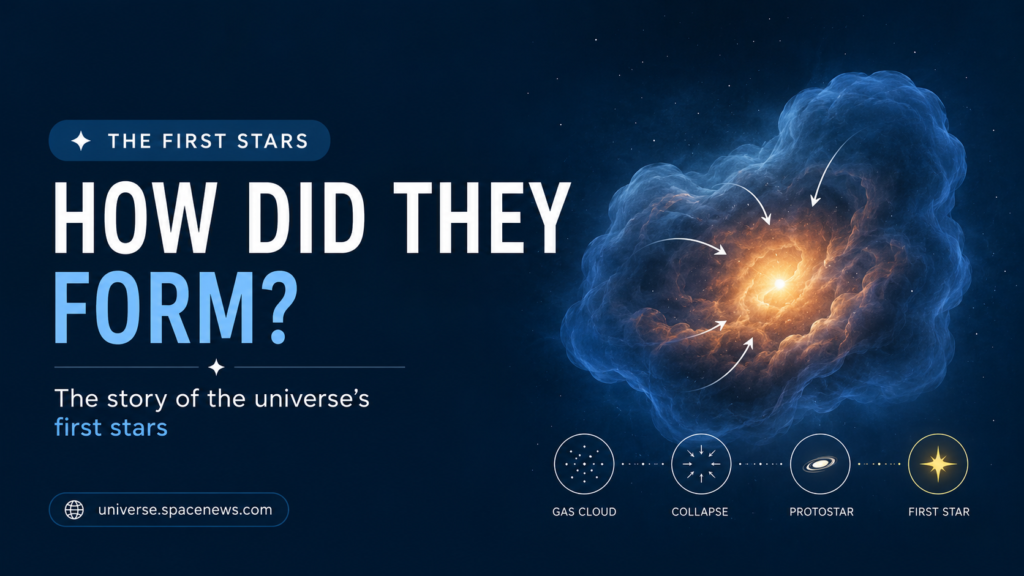
For more on the physical process itself, see [How Did the First Stars Form?].
Ancient Stars Preserve Chemical Clues
Some of the oldest stars observed today contain extremely small amounts of heavy elements.
They are not Population III stars themselves. Their presence of even tiny amounts of heavier elements tells astronomers that the gas from which they formed had already been enriched by earlier stars.
By measuring the amounts of different elements in these ancient stars, researchers can investigate what earlier generations of stars may have produced.
This field is sometimes called stellar archaeology.
The idea is similar to studying an archaeological site: the original object may be gone, but traces left behind can still reveal information about what existed before it.
Studies of extremely metal-poor stars have become an important way of constraining the properties and chemical output of the first generations of stars.
Telescopes Can Look Back Toward Cosmic Dawn
Modern telescopes can observe extremely distant galaxies whose light has traveled for billions of years.
The James Webb Space Telescope, in particular, is designed to study some of the earliest galaxies and stars in cosmic history. Such observations can reveal conditions from an era much closer to the emergence of the first stellar populations.
But there is an important limit: observing an extremely distant early galaxy is not the same as directly identifying one Population III star.
Scientists are still searching for convincing signatures of these first-generation stars. Direct detection remains difficult, and current research combines observations with theoretical models and other indirect constraints.
Why Did the First Stars Matter?
The first stars were important because they began changing a universe that had been chemically simple.
Their nuclear reactions produced heavier elements. When some of these stars died, those elements could be released into surrounding gas. Later stars could then form from material that was chemically different from the gas available to the first generation.
The radiation from massive early stars also affected their surroundings.
Exactly how these processes influenced the later development of cosmic structures is still being investigated. The details are complex, and scientists continue to refine their models of how the first stars interacted with their environment.
The important point for this article is simpler:
The first stars began the transition from a universe containing mostly hydrogen and helium to one containing the diverse elements found in stars, planets and living things today.
Their story therefore connects the nearly pristine early universe with the much more chemically complex cosmos that came later.
So, How Different Were the First Stars From Today’s Stars?
The simplest answer is that the first stars were probably different in several fundamental ways.
They formed from almost metal-free gas, while today’s stars usually contain at least some heavier elements. Many models predict that the first stellar generation included unusually massive stars, and those stars would have been much hotter, brighter and shorter-lived than the Sun.
But not every detail is settled.
Scientists have not yet directly confirmed an individual Population III star, and the exact range of their masses, lifetimes and final fates remains an active research question.
What we have is a strong scientific framework built from physics, simulations and observations of later generations—not a complete photograph of the first stellar population.
Conclusion
The first stars were probably unlike most stars we see today. They formed from nearly pristine gas dominated by hydrogen and helium, before earlier stars had enriched the universe with heavier elements. Many theoretical models suggest that at least some were extremely massive, hot, luminous and short-lived.
Yet there is an important limit to what scientists can say with certainty. No individual Population III star has been directly confirmed, so their properties are reconstructed from simulations, stellar physics, observations of the distant universe and chemical evidence preserved in ancient stars.
Their brief lives nevertheless marked an important stage in cosmic history. They began producing and distributing heavier elements, helping create the chemical environment from which later generations of stars could form.
The first stars did not look exactly like today’s stars because they were born into a universe that did not yet contain the ingredients that later stars inherited.
Frequently Asked Questions
What were the first stars called?
The first generation of stars is known as Population III, or Pop III, stars. They are expected to have formed from primordial gas containing essentially no elements heavier than helium.
Were the first stars bigger than the Sun?
Many models suggest that at least some first-generation stars were much more massive than the Sun. However, scientists do not yet know the exact mass distribution of Population III stars.
Were the first stars hotter than the Sun?
Probably. Models of massive Population III stars predict extremely high temperatures and strong ultraviolet radiation. Some models allow surface temperatures around 100,000 kelvins for very massive examples.
Have scientists seen a first star?
Not yet as a confirmed individual Population III star. Astronomers are looking for indirect signatures in the early universe and chemical evidence preserved in ancient, metal-poor stars.
Why can’t we see the first stars today?
The most massive first stars would have lived only a few million years, so they would have died billions of years ago. Smaller Population III stars, if they formed in significant numbers, could theoretically have survived much longer, which is one reason astronomers continue searching for metal-free stars today.