What Happened One Second After the Big Bang? Inside the Newborn Universe
One second seems almost meaningless on a human timescale.
But one second after the Big Bang, the universe was already undergoing enormous physical changes.
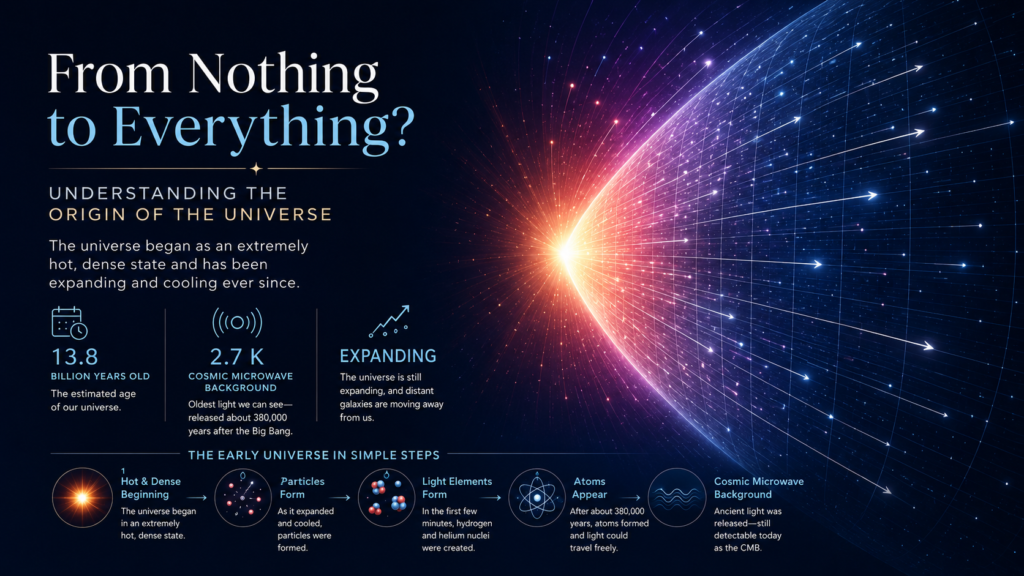
It was expanding and cooling from an extraordinarily hot, dense state. The temperature was around 10 billion kelvin, or roughly 10 billion°C, according to NASA.
There were no stars, galaxies, planets, or atoms.
Instead, the universe was filled with an extremely hot mixture of particles and radiation. Electrons, positrons, neutrinos, protons, neutrons, and photons were interacting in conditions unlike anything that exists naturally today.
And something important was already happening.
As the universe expanded, its density and temperature fell. That changed how often particles collided and how efficiently different reactions could occur.
So the story of what happened one second after the Big Bang is really a story about a universe changing its physical conditions as it expanded.
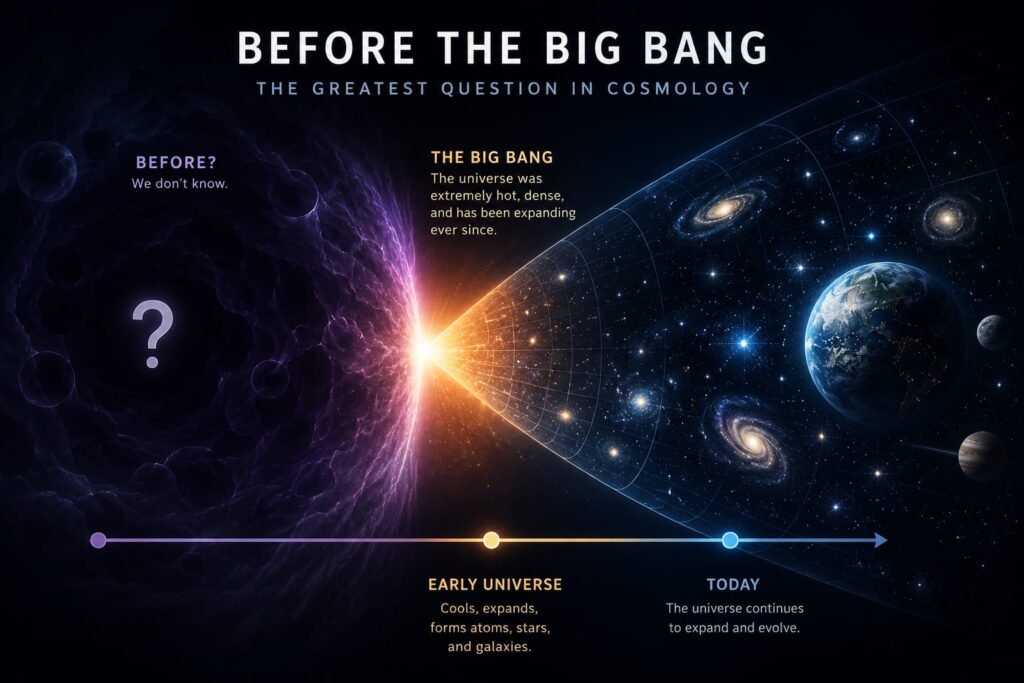
Before going further, one clarification matters: the Big Bang was not an explosion of matter into pre-existing empty space. The Big Bang model describes the early universe as having been much hotter and denser and then expanding and cooling. It does not tell us with certainty what happened at an absolute “time zero,” nor does it establish that the universe came from nothing.
This article begins after that earliest uncertain boundary and focuses on what physics can tell us about the universe around its first second.
What Did the Universe Look Like One Second After the Big Bang?
Imagine removing almost everything familiar about the modern universe.
Remove the stars.
Remove the galaxies.
Remove the planets.
Remove even the atoms that make up ordinary matter.
What remains is not an empty void.
It is an intensely hot, dense environment filled with particles and radiation.
NASA describes the universe at roughly one second as an extremely hot primordial soup of light and particles, with a temperature of about 10 billion K.
A universe filled with particles, not planets
At this stage, the universe contained many of the particles that would eventually become the building blocks of ordinary matter.
There were protons and neutrons, which are the particles found inside the nuclei of atoms. There were also electrons, positrons, neutrinos and enormous numbers of photons—the particles of light.
But this does not mean that ordinary matter already existed in the form we know today.
A proton is not a hydrogen atom.
A neutron is not a helium nucleus.
And none of these particles had assembled into stars, planets, rocks, oceans or anything resembling familiar objects.
The environment was simply too hot and energetic.
Photons were also unable to travel freely over large distances. They repeatedly interacted with charged particles, particularly electrons, making the early universe opaque—more like a dense fog than the transparent space we see today.
The important point is that the universe was already changing.
As it expanded, it became less dense and cooler.
That had consequences for the particles inside it.
The First Major Change: Neutrinos Begin to Break Free
One of the most important transitions around this period involved neutrinos.
A neutrino is an electrically neutral elementary particle that interacts extremely weakly with ordinary matter. Today, enormous numbers of neutrinos pass through space—and even through Earth—without interacting.
The early universe was different.
When the universe became too thin for neutrinos to keep interacting
During the earliest stages, the universe was so dense that neutrinos interacted frequently with other particles despite their weak interactions.
But expansion gradually changed that environment.
The basic sequence was:
Expansion → lower density → fewer collisions → weaker interactions
As the universe expanded and cooled, particles became more widely separated on average. Eventually, interactions involving neutrinos became too infrequent to keep them tightly coupled to the surrounding plasma.
Around the one-second timescale, neutrinos decoupled from the ordinary matter in the hot universe and began traveling much more freely through space.
It is important not to imagine this as a switch that suddenly flipped at exactly 1.000 seconds. “Around one second” is an approximate timescale for a gradual physical transition.
But the consequence was profound.
The universe was beginning to preserve information from its earliest conditions in particles that could travel onward with relatively little interaction.
These ancient neutrinos should still exist today as part of what scientists call the cosmic neutrino background. Detecting this background directly remains extremely difficult because neutrinos interact so weakly with matter.
That makes them potentially valuable messengers from an era far earlier than the cosmic microwave background.
The Neutron–Proton Balance Was Starting to Change
Another important process involved two particles that would later become essential ingredients of atomic nuclei:
protons and neutrons.
At the extreme temperatures of the early universe, reactions involving neutrinos, electrons, positrons, protons and neutrons could convert neutrons into protons and protons into neutrons.
As long as these reactions happened rapidly compared with the expansion of the universe, the neutron-to-proton ratio could keep adjusting toward thermal equilibrium.
But expansion was continuously cooling the universe.
Eventually, the reactions became too slow to maintain that equilibrium perfectly.
The universe was cooling faster than some reactions could keep up
This is one of the central ideas in understanding the early universe.
The universe did not simply become colder.
Its changing temperature and density altered which particle reactions could continue efficiently.
As the expansion rate became increasingly important compared with the rates of particle interactions, the neutron-to-proton ratio began to depart from its earlier equilibrium behavior. Around this period, the conditions were being established for the nuclear reactions that would follow during the next few minutes.
This may sound like a small change.
It was not.
Why the neutron–proton balance mattered later
The number of neutrons that survived into the next stage of cosmic evolution would help determine how much helium the universe could eventually produce.
Why?
Because protons and neutrons would soon begin combining into atomic nuclei.
During the following few minutes, the universe would enter an era known as Big Bang nucleosynthesis—the formation of light atomic nuclei in the early universe. NASA identifies hydrogen, helium, and traces of lithium and beryllium among the products of this period.
The one-second universe therefore helped set the conditions for what happened several minutes later.
Why One Second Was Already So Different From the Beginning
This is perhaps the most important idea to take away from the first second.
The universe was not simply getting bigger. It was changing physically as it expanded.
Expansion affected almost everything.
As the universe expanded:
- its temperature decreased;
- its density decreased;
- particle collisions became less frequent;
- some reactions became too slow to maintain equilibrium;
- particles such as neutrinos began to decouple from the surrounding matter;
- conditions gradually became suitable for new kinds of reactions.
This gives us a better way to picture cosmic evolution.
It was not:
Explosion → empty space → matter → stars → galaxies
The Big Bang model instead describes an evolving universe in which:
Hot, dense early state → expansion → cooling → changing particle interactions → formation of increasingly complex structures
That distinction is important.
The Big Bang was not an explosion happening at one location inside an already existing universe. The expansion described by the model concerns space itself. When cosmologists talk about the early universe being smaller, hotter and denser, they are describing the state of the universe as a whole—not matter flying outward from a central point into empty space.
And by the time the universe was about one second old, that expansion had already transformed its physical environment dramatically.
What Happened After the First Second?
The one-second mark was not the end of this transition.
It was the beginning of another important stage.
The universe continued expanding and cooling. Over the following minutes, protons and neutrons began combining through nuclear reactions.
This was Big Bang nucleosynthesis.
The process produced mostly the nuclei of hydrogen and helium, along with much smaller amounts of other light nuclei. NASA notes that most of today’s helium had formed within the first several minutes.
But these were still atomic nuclei, not complete atoms.
Electrons were still moving through the hot, dense environment, and the universe remained opaque to light.
It would take roughly 380,000 years before the universe cooled enough for electrons to combine with nuclei and form stable atoms. At that point, photons could finally travel much more freely, producing the cosmic microwave background we observe today.
That later transition is an important chapter of its own.
For now, the key point is that the universe had moved from an extremely hot particle-dominated state toward the first light atomic nuclei—the ingredients from which ordinary matter would eventually develop.
One Second After the Big Bang: What Do Scientists Actually Know?
It is easy to make the early universe sound more certain than it really is.
Scientists have strong evidence for the broad picture of an expanding, cooling universe and for the formation of light elements in the first few minutes.
The cosmic microwave background, the observed expansion of the universe, and the measured abundances of light elements all provide important evidence supporting the standard cosmological model.
But the closer we try to get to the very beginning, the more uncertain the picture becomes.
The Big Bang model does not establish what happened at an absolute time zero.
It also does not establish that the universe came from “nothing.”
And ideas about what happened before the earliest phase described by established cosmology—including different proposals involving inflation or hypothetical pre-Big-Bang scenarios—belong to areas of active research rather than settled history.
Inflation itself is a leading theoretical framework for describing a very early period of extremely rapid expansion, and observations of the universe’s large-scale structure provide important clues about conditions associated with it. But the detailed physics of that earliest period is not known with the same confidence as the later, better-tested stages.
That distinction matters.
Science is not weakened by acknowledging what remains unknown.
It becomes more trustworthy.
One Second After the Big Bang — The Bigger Picture
At roughly one second old, the universe was nothing like the cosmos we see today.
It was:
- around 10 billion K;
- expanding and cooling;
- filled with particles and radiation;
- still opaque to light;
- beginning to allow neutrinos to travel freely;
- undergoing changes in the balance between protons and neutrons;
- approaching the conditions required for the first major episode of nuclear element formation.
There were still no stars.
No galaxies.
No planets.
No ordinary atoms.
Yet the foundations for all of them were already being established.
The universe we see today is about 13.8 billion years old.
One second was an almost unimaginably small fraction of that history.
But that single second was enough for expansion and cooling to change the behavior of the universe’s fundamental particles.
And that leads to the deeper lesson of the early universe:
The first second did not create the universe we see today. It established the physical conditions that allowed that universe to emerge.
Over the next few minutes, protons and neutrons would begin forming the first light atomic nuclei.
Much later, atoms would appear.
Then stars and galaxies.
But none of those later structures make sense without understanding this earlier stage—when the universe was still a hot, expanding sea of particles and radiation, changing from moment to moment.
Frequently Asked Questions
Was the universe an explosion one second after the Big Bang?
No.
The Big Bang is not best understood as an explosion occurring at a particular point in pre-existing space. The standard model describes the universe itself evolving from an extremely hot, dense early state as space expanded.
How hot was the universe one second after the Big Bang?
NASA gives a temperature of approximately 10 billion kelvin, or about 10 billion°C, for the universe at around one second.
Were atoms present one second after the Big Bang?
No. The universe was far too hot for stable ordinary atoms to exist. Protons and neutrons were present, but the formation of light atomic nuclei occurred during the following few minutes, while complete atoms formed much later.
What happened to neutrinos after one second?
As the universe expanded and its density fell, neutrinos interacted less frequently with other particles. Around the one-second timescale, they decoupled from the surrounding matter and began traveling much more freely through space.
What formed after the first second?
During the following few minutes, nuclear reactions produced mostly hydrogen and helium nuclei, with traces of other light nuclei. This period is called Big Bang nucleosynthesis.
How do scientists know what the early universe was like?
Scientists combine several independent lines of evidence, including the universe’s observed expansion, the cosmic microwave background, and the measured abundance of light elements. Together, these observations strongly support the broad picture of a hotter, denser early universe that expanded and cooled.