What Was the Universe Like Before Stars Existed?
Today, the universe is filled with stars and galaxies. But there was a long period in cosmic history when none of them existed.
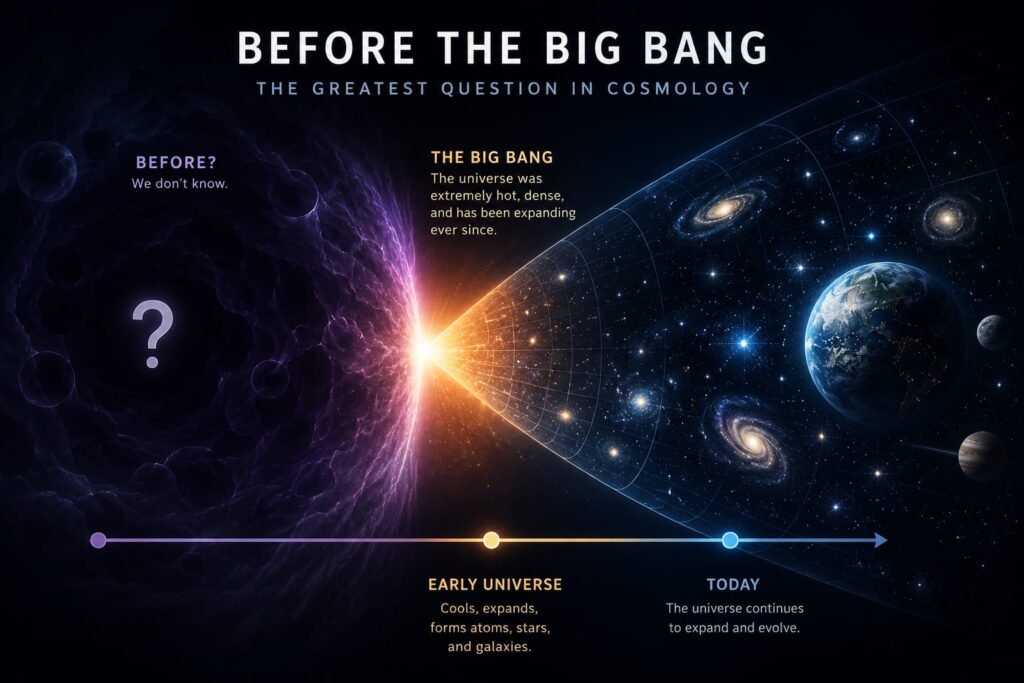
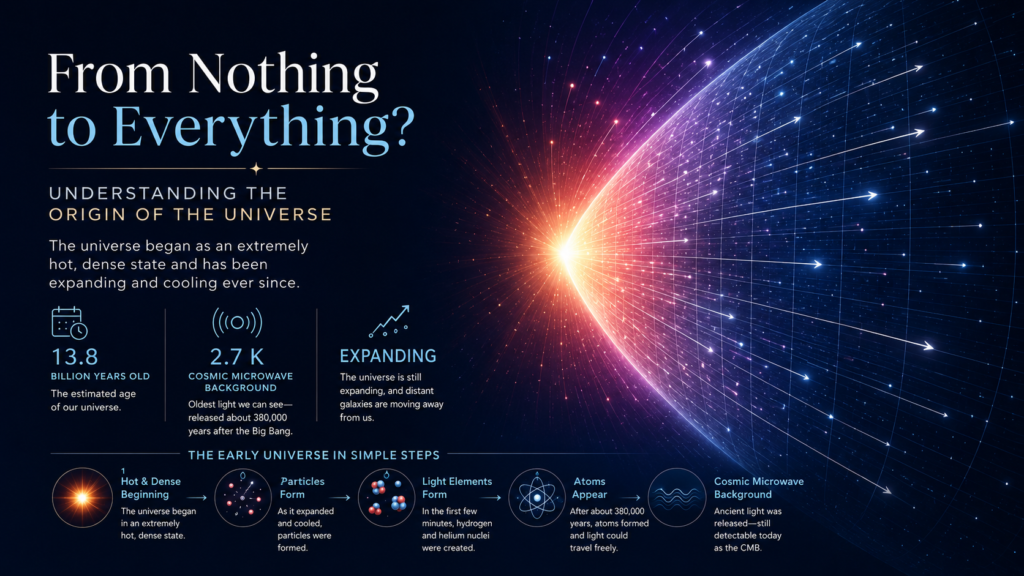
About 380,000 years after the beginning of the universe’s expansion, the universe had cooled enough for electrons to combine with atomic nuclei, forming mostly neutral hydrogen and helium. At this stage, light could travel much more freely through space. The ancient radiation released at this time is what we now observe as the cosmic microwave background (CMB).
But there were still no stars.
The universe entered what astronomers call the Cosmic Dark Ages—a period before the first stars began to shine.
So, what was the universe like before stars existed?
It was a relatively simple universe filled mainly with neutral hydrogen and helium. Dark matter was also present, and tiny differences in the distribution of matter were already providing the seeds for later cosmic structure.
The universe was dark in terms of starlight, but it was not empty or inactive.
Gravity was gradually bringing matter together, setting the stage for the first stars.
What Happened After the First Atoms Formed?
The Universe Was Mostly Hydrogen and Helium
The formation of neutral atoms was a major transition in cosmic history.
Before this point, free electrons interacted frequently with photons, making the universe opaque. Once most electrons became bound to atomic nuclei, there were far fewer free electrons available to scatter light. The cosmic fog cleared, allowing light to travel across space.
The ordinary matter in the universe was also chemically simple.
It consisted mainly of hydrogen and helium, with tiny amounts of other light elements produced during the universe’s early history.
There was almost none of the heavier material that is common in the universe today.
Elements such as carbon, oxygen and iron would become abundant only later, through processes associated with stars and stellar evolution.
That meant the universe already contained the basic gas from which stars could eventually form.
But there was an important problem:
The gas was spread out.
For a star to form, gravity must gather enough gas into a dense region for that region to collapse.
That process had only just begun.
The Dark Ages Were Not an Empty Void
The name Cosmic Dark Ages can be misleading.
It does not mean that the universe was completely empty or that nothing was happening.
There were vast amounts of neutral hydrogen gas, along with helium and dark matter.
More importantly, matter was not distributed perfectly evenly.
Some regions were slightly denser than others.
Those small differences mattered because gravity is sensitive to the distribution of matter.
A slightly denser region has a stronger gravitational pull. As it attracts more matter, it can become denser still.
Over very long periods, these small differences could grow into much larger structures.
ESA describes this period as one in which gravitational structures associated with gas and dark matter were growing larger and denser after the CMB was released.
So although the universe had no stars yet, its structure was already beginning to change.
Why Was the Universe Dark?
There Were No Stars to Produce Starlight
Once the universe became transparent, light could travel freely over large distances.
But this did not mean stars had already formed.
There were no individual stellar sources illuminating the universe.
That is why astronomers use the term Dark Ages for this period. ESA describes it as the era after recombination and before the emergence of the first stars, when there were no individual sources of light such as stars.
The important distinction is:
The universe was dark because stars had not yet formed—not because nothing existed.
There was gas.
There was dark matter.
There was radiation.
And gravity was already shaping the distribution of matter.
The Universe Still Had the Cosmic Microwave Background
It would therefore be inaccurate to say that the universe contained no light.
The cosmic microwave background was already traveling through space.
The CMB is the oldest light we can directly observe. It was released when the universe was about 380,000 years old, and cosmic expansion has stretched its wavelengths so that we detect it today primarily as microwave radiation.
The CMB is especially important because it provides scientists with a snapshot of the universe before stars existed.
And that snapshot contains clues about how stars and galaxies eventually formed.
The Tiny Differences That Became the Seeds of Structure
The Early Universe Was Not Perfectly Smooth
If the early universe had been perfectly uniform, gravity would have had no obvious regions from which large structures could grow.
But the CMB shows that the young universe contained tiny variations in temperature and density.
ESA’s Planck observations show these small fluctuations, which correspond to regions that had slightly different densities and later became the seeds of cosmic structure.
Think of it like a nearly flat landscape with extremely shallow hills and valleys.
At first, the differences are small.
But once gravity begins acting over enormous periods, the slightly denser regions can attract more matter.
That is the basic beginning of structure formation.
Gravity Gradually Amplified Those Differences
A region containing slightly more matter has a stronger gravitational influence.
It can attract additional matter from its surroundings.
As more matter gathers, the region becomes denser, strengthening its gravitational pull.
This does not mean every small fluctuation automatically became a star. Many processes influence how structures grow.
But the general picture is well established: the small irregularities visible in the CMB provided the initial seeds from which later cosmic structures developed.
This is one of the most powerful connections in modern cosmology.
Astronomers can observe the early universe’s tiny fluctuations and compare them with the large-scale structures that developed much later.
How Did Dark Matter Help?
Dark Matter Provided an Important Gravitational Framework
Another part of this story is dark matter.
Dark matter is a form of matter that does not appear to absorb, emit or reflect light in the same way ordinary matter does. Scientists infer its presence primarily from its gravitational effects.
You do not need to imagine dark matter as invisible gas floating around individual stars.
At the scale of the early universe, its gravitational influence helped create regions where matter could accumulate.
In the standard model of cosmic structure formation, dark matter began developing dense structures, while ordinary matter—including hydrogen and helium—could later gather within those gravitational environments. ESA’s description of structure formation connects the growth of primordial fluctuations in dark matter with the development of later cosmic structures.
This is why the first stars did not simply appear randomly throughout space.
They emerged from a universe in which gravitational structure had been developing for millions of years.
Why Did the First Stars Take So Long to Form?
Gravity Had to Build the Right Conditions
The universe already had hydrogen and helium.
So why didn’t stars form immediately after atoms appeared?
Because having gas is not enough.
The gas needed to become sufficiently concentrated.
As denser regions grew under gravity, ordinary matter accumulated in them. In some regions, the gas could become dense enough for gravity to drive further collapse.
As a cloud collapses, gravitational energy is converted into heat, raising the temperature and density toward its center.
Eventually, some of these collapsing clouds could reach the conditions required for nuclear fusion.
That is when the first stars could begin shining.
The overall process took a very long time compared with the age of the universe at recombination.
ESA places the Dark Ages between about 380,000 years after the beginning of cosmic expansion and the emergence of the first stars and galaxies a few hundred million years later.
When Did the First Stars Actually Appear?
This is where scientists have to be careful.
There is no directly observed first star with a confirmed birth date.
NASA states that scientists do not know exactly when the first stars began shining. They must have formed after recombination, about 380,000 years after the beginning of cosmic expansion, and before the oldest galaxies we can observe.
Some theoretical models predict that the first stars could have formed relatively early, but the precise timing depends on the details of how the earliest structures grew and how gas behaved inside them.
So it is better to say:
The first stars probably formed within the first few hundred million years of cosmic history, but their exact birth time remains uncertain.
That is a good example of the difference between a well-supported cosmic timeline and a detail that scientists are still investigating.
What Was the Universe Like During the Cosmic Dark Ages?
There Were No Mature Galaxies Like the Milky Way
The universe during this era looked very different from the cosmos we see today.
There were no mature spiral galaxies like the Milky Way.
There were no planetary systems like our Solar System.
There were no generations of stars enriching space with heavier elements.
Instead, the universe contained large amounts of primordial gas and growing gravitational structures.
The first galaxies would emerge only after stars had begun forming and gravitational structures continued to grow.
This is also why the Cosmic Dark Ages cannot be described as simply “nothingness.”
The universe was undergoing structural evolution even though it lacked the brilliant sources of light that dominate modern astronomical images.
The Universe Was Chemically Simple but Structurally Evolving
This distinction is worth remembering.
Chemically, the universe was simple.
Hydrogen and helium dominated ordinary matter.
Structurally, however, the universe was becoming more complicated.
Density differences were growing.
Dark matter was influencing gravitational structure.
Gas was gathering into denser regions.
The conditions required for the first stars were gradually emerging.
So the Dark Ages were not a pause in cosmic history.
They were a stage of cosmic evolution.
How Do Scientists Know What Happened Before the First Stars?
The first stars themselves have not been directly observed, so how can scientists describe the universe before them?
The answer comes from combining different types of evidence with physical models.
The Cosmic Microwave Background
The CMB provides a direct observational window into the universe when it was about 380,000 years old.
Its tiny variations reveal differences in the density of matter at that time.
These variations are important because they provide the initial conditions for models of how cosmic structure grew.
Distant Galaxies
Because light travels at a finite speed, observing a very distant galaxy means observing it as it existed billions of years ago.
Telescopes such as the James Webb Space Telescope are now observing galaxies from extremely early cosmic history.
These observations help astronomers investigate how the first generations of stars and galaxies developed.
However, observing an early galaxy is not the same as directly observing the first star.
NASA notes that the first stars themselves have not yet been directly detected.
Cosmological Models
Scientists also use models based on known physical laws to calculate how small density differences should evolve under gravity.
When these models successfully reproduce observations of later cosmic structure, they provide a way to test our understanding of the universe’s evolution.
This leads to an important distinction:
We directly observe the CMB and its fluctuations.
We use observations, physics and models to reconstruct what happened afterward.
The exact properties and timing of the first stars remain uncertain.
That distinction is not a weakness of cosmology. It is how science works when studying events from billions of years ago.
From the Cosmic Dark Ages to Cosmic Dawn
Eventually, some regions became dense enough for the first stars to form.
When gas collapsed sufficiently, the pressure and temperature in the centers of these early stellar objects could become high enough for hydrogen fusion to begin. NASA describes this process as the transition from collapsing gas clouds to the first stars.
The appearance of the first stars changed the universe again.
Their ultraviolet radiation began interacting with the surrounding neutral hydrogen. This contributed to reionization, the process in which much of the hydrogen between galaxies became ionized.
This transition toward a universe increasingly illuminated by stars is known as Cosmic Dawn.
But it was not an instant transformation.
The universe did not suddenly go from darkness to a sky filled with galaxies.
Instead, the change unfolded gradually:
First atoms formed
↓
The universe became transparent
↓
The Cosmic Dark Ages began
↓
Tiny density differences provided seeds for structure
↓
Gravity amplified those differences
↓
Dark matter and ordinary matter gathered into increasingly dense structures
↓
Gas collapsed in some regions
↓
The first stars formed
↓
Cosmic Dawn began
The universe had spent hundreds of millions of years building toward that transition.
What We Know—and What We Still Don’t Know
The story of the universe before the first stars is a useful example of how cosmology separates evidence from inference.
What Scientists Know
- The universe is approximately 13.8 billion years old.
- The CMB was released when the universe was about 380,000 years old.
- The early universe contained mostly hydrogen and helium.
- Tiny density fluctuations are visible in the CMB.
- The first stars formed after recombination and before the oldest galaxies we observe.
What Scientists Strongly Infer
- Gravity amplified early density differences.
- Dark matter played an important role in the growth of cosmic structure.
- Gas accumulated in increasingly dense gravitational environments.
- Some of those regions eventually collapsed and formed the first stars.
What Scientists Still Don’t Know
- The exact moment when the first stars formed.
- The precise properties of the first stars.
- Exactly how the earliest stellar populations developed.
- How the first stars and galaxies interacted during the earliest stages of Cosmic Dawn.
NASA emphasizes that the first stars themselves have not been directly detected, and their properties remain an active area of research.
Frequently Asked Questions
How long was the universe without stars?
The universe had no stars during the period following recombination and before the first stars appeared. Recombination occurred about 380,000 years after the beginning of cosmic expansion, while the exact timing of the first stars remains uncertain. They formed sometime before the oldest galaxies we can observe.
What was the universe made of before the first stars?
Ordinary matter consisted mainly of neutral hydrogen and helium, with tiny amounts of other light elements. Dark matter was also present and played an important gravitational role in the development of cosmic structure.
Why was the early universe dark?
There were no stars yet to produce starlight. However, the universe was not completely without radiation. The cosmic microwave background had already been released and was traveling through space.
Did galaxies exist before the first stars?
Not in the form we understand as galaxies today. The gravitational structures that later developed into galaxies were already growing, but stars had to form before galaxies could become stellar systems. The precise details of the earliest galaxy formation remain an active research area.
How did the first stars form?
Gravity gathered primordial gas into increasingly dense regions. In some of those regions, gravitational collapse eventually produced temperatures and pressures high enough for nuclear fusion to begin. The exact properties of the first stars remain uncertain.
How old is the universe?
The universe is approximately 13.8 billion years old according to current cosmological measurements.