If the early universe was unimaginably hot, how did the first atoms form?
The answer begins with an important distinction: the universe did not start out filled with ordinary atoms.
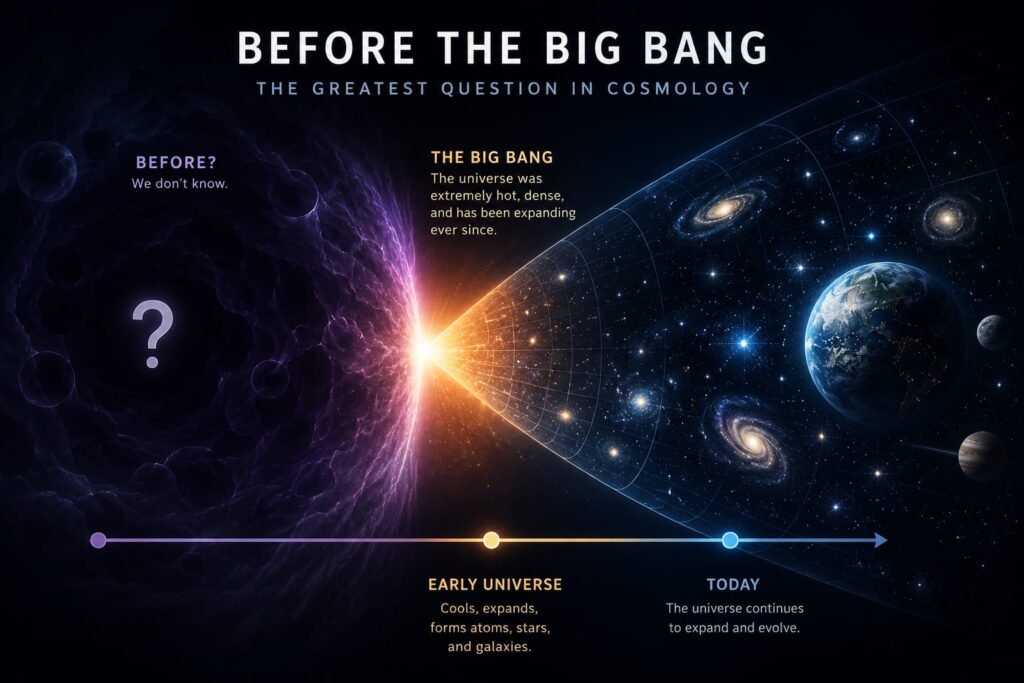
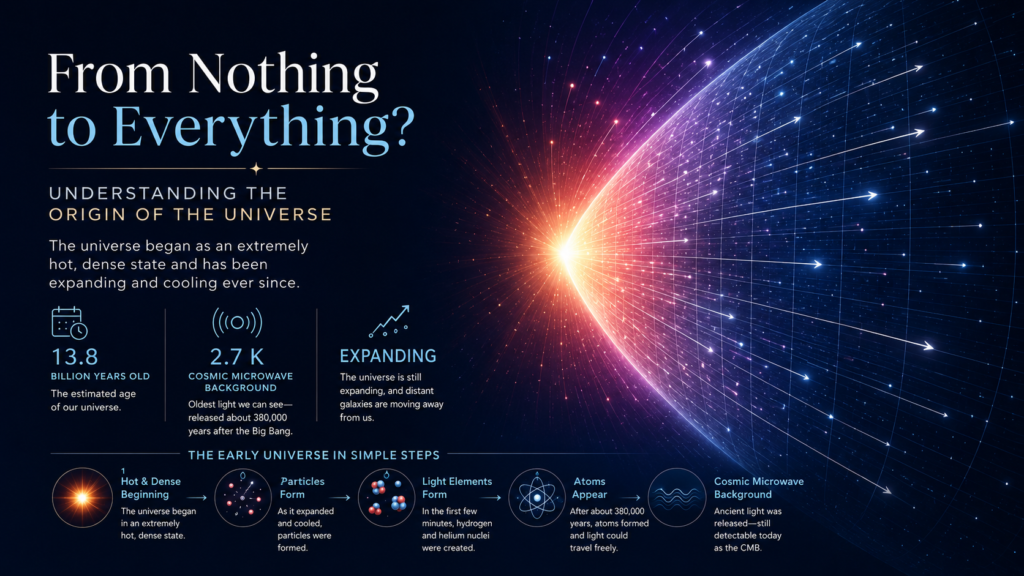
According to the modern Big Bang model, the universe has been expanding and cooling for about 13.8 billion years. In its early, hot state, matter existed as a dense plasma of particles and radiation rather than as the atoms we see today. As the universe expanded, it cooled. Within the first few minutes, protons and neutrons combined through nuclear reactions to form the nuclei of the lightest elements.
But those were not yet complete atoms.
A neutral atom needs electrons bound to its nucleus. The early universe was too hot for electrons to remain attached to nuclei for long. It took roughly 380,000 years of continued expansion and cooling before conditions allowed electrons to settle into stable atomic states.
The basic sequence was:
hot plasma → atomic nuclei → expansion and cooling → electrons bind to nuclei → neutral atoms → transparent universe
That transition was one of the most important stages in cosmic history. It not only produced the first neutral atoms but also allowed light to travel freely across space. The ancient radiation released during this era is what we now observe as the cosmic microwave background (CMB).
Before Atoms, There Were Atomic Nuclei
To understand how the first atoms formed, it helps to separate two ideas that are often treated as the same thing: an atomic nucleus and an atom.
An atom consists of a central nucleus surrounded by electrons. The nucleus contains positively charged protons and, except in ordinary hydrogen, neutrons.
So when scientists say that the first light elements formed during the early universe, they are not saying that complete atoms already existed.
Why atoms could not exist in the early universe
The early universe was extremely hot and dense.
Under those conditions, energetic photons and particles interacted constantly with matter. Even when an electron became associated with a positively charged nucleus, energetic interactions could knock it free again.
The result was a plasma — a state of matter in which electrons and atomic nuclei are not bound together into neutral atoms.
A useful analogy is trying to build a delicate structure during a storm. The ingredients are present, but the environment is too energetic for the structure to remain intact.
So atoms were not impossible in principle. The early universe simply had not cooled enough for neutral atoms to survive.
NASA describes the universe before recombination as a hot, dense plasma in which free electrons scattered photons, preventing light from traveling freely over long distances.
The first few minutes built the nuclei
The first major step toward atoms occurred within the first few minutes through Big Bang nucleosynthesis, usually shortened to BBN.
Nucleosynthesis simply means the formation of atomic nuclei.
As the universe expanded and cooled, protons and neutrons could participate in nuclear reactions. These reactions produced mainly the nuclei of hydrogen and helium, along with smaller amounts of deuterium, helium-3 and lithium-7.
The process did not create large quantities of every element in the periodic table. Instead, the early universe emerged from this nuclear phase with a remarkably simple chemical composition dominated by hydrogen and helium.
Big Bang nucleosynthesis is important because scientists can calculate the expected abundances of these light elements and compare them with observations. The broad agreement between predictions and measurements is one of the major successes of the hot Big Bang model.
But there was still a major problem:
the nuclei had formed, but the atoms had not.
Why Did the Universe Have to Wait Hundreds of Thousands of Years?
If hydrogen and helium nuclei existed within minutes, why did ordinary atoms take about 380,000 years to appear?
The answer is cooling.
Expansion made the universe cooler
The universe continued to expand after the earliest stages of its history.
As it expanded, its temperature and density decreased. The particles became less energetic, and interactions that had previously prevented electrons from remaining bound to nuclei became less disruptive.
The important sequence is:
expansion → cooling → fewer energetic interactions → electrons can remain bound to nuclei
This is why the formation of atoms was not an instantaneous event.
The universe needed time to reach the right physical conditions.
This also fits into the larger timeline explored in the earlier articles of the Cosmic Origin series. The very early universe went through several different physical stages, but the formation of atoms occurred long after the first second and long after the period scientists call cosmic inflation.
Inflation itself is a theoretical model proposed to explain several features of the early universe; the details of what drove inflation remain an active area of research. The formation of atoms, however, is a much later and better-understood stage of cosmic evolution.
The universe was still a cosmic plasma
For hundreds of thousands of years, the universe remained filled with a mixture of:
- free electrons
- positively charged atomic nuclei
- photons
- other particles
Because electrons were free, photons interacted with them frequently.
This had an important consequence:
light could not travel freely through the universe.
A photon could move for a while, encounter a free electron, scatter, and change direction. It happened so often that the early universe was effectively opaque — more like a cosmic fog than the transparent universe we observe today.
So there was already plenty of light in the early universe.
The problem was that the light could not travel very far without interacting with matter.
The Moment the First Neutral Atoms Could Form
Eventually, continued expansion and cooling changed the situation.
Electrons finally found stable homes
Around 380,000 years after the Big Bang, the universe had cooled to roughly 3,000 K.
At this temperature, electrons could remain bound to atomic nuclei for much longer. Protons captured electrons to form neutral hydrogen atoms, while helium nuclei also acquired electrons and became neutral helium atoms.
For hydrogen, the basic idea can be represented as:
proton + electron → neutral hydrogen atom
This looks simple, but it represents a major change in the history of the universe.
Before this transition, most ordinary matter was electrically charged.
After it, most ordinary matter had become electrically neutral.
This period is called recombination.
Why do scientists call it “recombination”?
The name can be slightly confusing.
In cosmology, recombination refers to the period when free electrons became bound to atomic nuclei and neutral atoms formed.
The terminology comes from the combination of charged particles into neutral atoms, although the early universe had not previously consisted of ordinary atoms in the familiar sense.
The name matters less than the physical process:
free electrons became bound to nuclei.
And that change had a consequence that reached far beyond the atoms themselves.
The Universe Became Transparent
The formation of neutral atoms transformed the way light moved through the cosmos.
Free electrons were the problem
Before recombination, photons repeatedly scattered from free electrons.
Once electrons became bound to nuclei, the number of free electrons fell dramatically.
Neutral hydrogen and helium interact much less strongly with the photons that make up the cosmic background radiation. As a result, photons could finally travel over enormous distances without being repeatedly scattered by free electrons.
The cosmic fog cleared.
The universe became transparent to the radiation that had previously been trapped in constant interactions with the plasma.
This is why the formation of atoms was not simply a chemical milestone.
It changed the observational universe.
The oldest light we can see was released
The transition to transparency is closely connected to the cosmic microwave background, or CMB.
The CMB is the relic radiation we observe from the time when the universe became transparent. These photons have been traveling through expanding space for almost the entire 13.8-billion-year history of the universe. As the universe expanded, their wavelengths stretched, shifting the radiation into the microwave part of the electromagnetic spectrum.
Today, the CMB has an effective temperature of about 2.7 K, much colder than the roughly 3,000 K radiation associated with the early universe.
The CMB is therefore not light from the first instant of the universe.
It is the oldest light we can directly observe — a record from when the universe was about 380,000 years old.
In other words, when we observe the CMB, we are seeing the universe at a time when neutral atoms were forming and the cosmic fog was clearing.
What Were the First Atoms Actually Made Of?
The first atoms were chemically simple.
The universe did not suddenly contain the full periodic table.
Hydrogen dominated
Hydrogen became the most abundant element in the early universe.
A neutral hydrogen atom contains one proton and one electron, making it the simplest ordinary atom.
Helium was the next major component, with tiny quantities of other light elements also present. NASA describes the post-recombination universe as being dominated by hydrogen and helium, with trace amounts of heavier elements.
These simple atoms later became the raw material for the first stars.
But that happened much later.
Helium was already present
Helium illustrates why the distinction between nuclei and atoms is so important.
Helium nuclei formed during Big Bang nucleosynthesis, within the first few minutes.
Neutral helium atoms formed much later, when those nuclei acquired electrons during recombination.
So the timeline is:
First few minutes: helium nuclei form.
~380,000 years: neutral helium atoms form.
The same basic distinction applies to hydrogen.
The proton existed much earlier; the neutral hydrogen atom appeared later when an electron became bound to it.
What about heavier elements?
The early universe did not produce significant quantities of elements such as carbon, oxygen, silicon or iron through Big Bang nucleosynthesis.
The process mainly produced the lightest elements.
Most of the heavier elements familiar from stars, planets and living organisms were produced later through stellar nucleosynthesis and other astrophysical processes. That is a separate chapter in the story of cosmic evolution.
For the universe at the time of recombination, the chemical inventory was still remarkably simple:
mostly hydrogen, a substantial amount of helium, and tiny traces of other light elements.
What Happened After the First Atoms?
The formation of atoms did not immediately produce stars or galaxies.
Instead, the universe entered a period known as the cosmic Dark Ages.
There were no stars shining across the universe yet. Most ordinary matter existed as neutral hydrogen and helium gas, while small differences in density provided the seeds from which larger structures could eventually grow.
Gravity gradually amplified these differences, drawing matter into denser regions.
Over much longer periods, some of these regions became dense enough for the first stars to form.
Exactly when the very first stars appeared is still uncertain. NASA states that they must have formed after recombination and before the oldest known galaxies, while current observations and models continue to refine our understanding of this period.
That story belongs to the next chapter.
The universe had its atoms. Now it had to figure out what to do with them.
How Do We Know the First Atoms Formed?
The formation of the first atoms is not based on a single observation.
Scientists reconstruct this period using several independent lines of evidence.
The cosmic microwave background
The CMB provides an observational window into the universe when it was about 380,000 years old.
Measurements from missions such as NASA’s WMAP and ESA’s Planck have mapped tiny variations in the CMB. These variations preserve information about the density and temperature conditions of the early universe and provide evidence for the conditions from which later cosmic structures developed.
The CMB is therefore much more than an ancient glow.
It is a record of the early universe at the moment when photons began traveling freely through space.
Primordial element abundances
Another important test comes from the light elements produced during Big Bang nucleosynthesis.
Scientists calculate how much deuterium, helium and lithium should have been produced under early-universe conditions. They then compare those predictions with observations of very old, relatively pristine cosmic material.
The agreement is particularly strong for deuterium and helium and provides an important quantitative test of the hot Big Bang model. The Particle Data Group describes the concordance between the CMB and light-element abundances as a significant success of Big Bang nucleosynthesis.
This gives scientists a coherent picture:
the early universe was hot → light nuclei formed → the universe expanded and cooled → neutral atoms formed → photons eventually traveled freely.
Why is the story not completely finished?
There is still an important unresolved issue known as the primordial lithium problem.
Standard Big Bang nucleosynthesis predicts more lithium-7 than is observed in some old, metal-poor stars. Scientists are investigating whether stellar processes, observational effects, nuclear physics or other explanations can account for the discrepancy. The latest Particle Data Group review continues to describe the cosmological lithium problem as unresolved.
This does not erase the broader success of Big Bang nucleosynthesis.
Instead, it illustrates how science works: a model can successfully explain a large body of evidence while still leaving specific problems for researchers to investigate.
The First Atoms Marked a Major Turning Point
The formation of the first atoms was not the moment when all matter suddenly appeared.
It was a major transition in the evolution of matter that already existed in the young universe.
The story can be summarized like this:
Hot, expanding early universe
↓
First few minutes: light atomic nuclei form
↓
Universe continues expanding and cooling
↓
~380,000 years: electrons become bound to nuclei
↓
Neutral hydrogen and helium atoms form
↓
Free electrons become much less abundant
↓
The universe becomes transparent
↓
Ancient photons travel freely and are observed today as the CMB
This distinction matters.
The first nuclei appeared within minutes, but the first stable neutral atoms appeared hundreds of thousands of years later.
The significance of that transition goes beyond the formation of hydrogen and helium.
Before it, the universe was a hot, opaque plasma.
After it, the cosmos was filled largely with neutral hydrogen and helium and had become transparent to its ancient radiation.
Those simple atoms would eventually provide the raw material for the first stars and galaxies.
The universe had taken another major step in its evolution.
And the next stage would be very different.
The First Atoms: A Quick Timeline
| Cosmic time | What happened |
|---|---|
| First seconds | The universe was an extremely hot, expanding environment filled with particles and radiation. |
| First few minutes | Big Bang nucleosynthesis produced the nuclei of the lightest elements. |
| First few minutes–hundreds of thousands of years | The universe remained a hot plasma of nuclei, electrons and photons. |
| ~380,000 years | Electrons became bound to nuclei, producing neutral atoms. |
| ~380,000 years | The universe became transparent and photons could travel freely over large distances. |
| Later | The cosmic Dark Ages were followed by the formation of the first stars and galaxies. |
The most important distinction in this timeline is simple:
nuclei first, neutral atoms much later.
Frequently Asked Questions
When did the first atoms form?
The first neutral atoms formed roughly 380,000 years after the Big Bang, when the expanding universe had cooled to around 3,000 K and electrons could remain bound to atomic nuclei.
What was the first atom?
Hydrogen was the simplest and most abundant atom to form. A neutral hydrogen atom consists of one proton and one electron.
Did hydrogen exist before the first atoms formed?
Yes. Hydrogen nuclei — individual protons — existed much earlier. During the first few minutes, nuclear reactions produced the nuclei of light elements. Much later, during recombination, electrons became bound to those nuclei and neutral hydrogen atoms formed.
Why couldn’t atoms form immediately after the Big Bang?
The early universe was too hot and energetic. Electrons could not remain bound to nuclei because interactions with energetic particles and photons continually disrupted atomic states. Atoms became stable only after the universe had expanded and cooled sufficiently.
What is recombination?
Recombination is the era when free electrons became bound to atomic nuclei, allowing neutral atoms to form. It occurred roughly 380,000 years after the Big Bang and was followed by the universe becoming transparent to light.
What is the cosmic microwave background?
The cosmic microwave background, or CMB, is ancient radiation released when the early universe became transparent. Cosmic expansion stretched its wavelengths over billions of years, so we detect it today as microwave radiation. It is the oldest light we can directly observe.
What happened after the first atoms formed?
The universe entered the cosmic Dark Ages. Neutral hydrogen and helium filled space while gravity gradually amplified small density differences. Much later, the first stars and galaxies formed. Exactly when the first stars appeared remains an area of active research.
What Comes Next?
The universe was no longer a hot, opaque plasma.
It had become a vast, mostly neutral cosmos filled with hydrogen and helium.
But there was still no starlight.
The tiny density differences preserved from the early universe were already being amplified by gravity. Over time, gas began collecting into denser regions, eventually creating the conditions for the first stars.
The first atoms had formed. The next question is how those atoms became the first stars.