The first galaxies did not appear as finished collections of stars. They grew from small differences in the distribution of matter in the young universe. Gravity gradually amplified those differences, dark matter gathered into increasingly massive halos, gas fell into them, and stars began to form inside these growing structures.
That is the basic story of how the first galaxies emerged.
The exact identity and formation time of the very first galaxy are still unknown. Astronomers have, however, observed galaxies from remarkably early in cosmic history and have developed physical models that explain how smaller structures could grow into the first galactic systems.
To understand how the first galaxies formed, we have to start before there were any galaxies at all.
What Existed Before the First Galaxies?
The early universe was not perfectly smooth.
There were tiny differences in the density of matter. Some regions contained slightly more matter than their surroundings, while others contained slightly less. These variations were small, but they became the seeds from which cosmic structure grew.
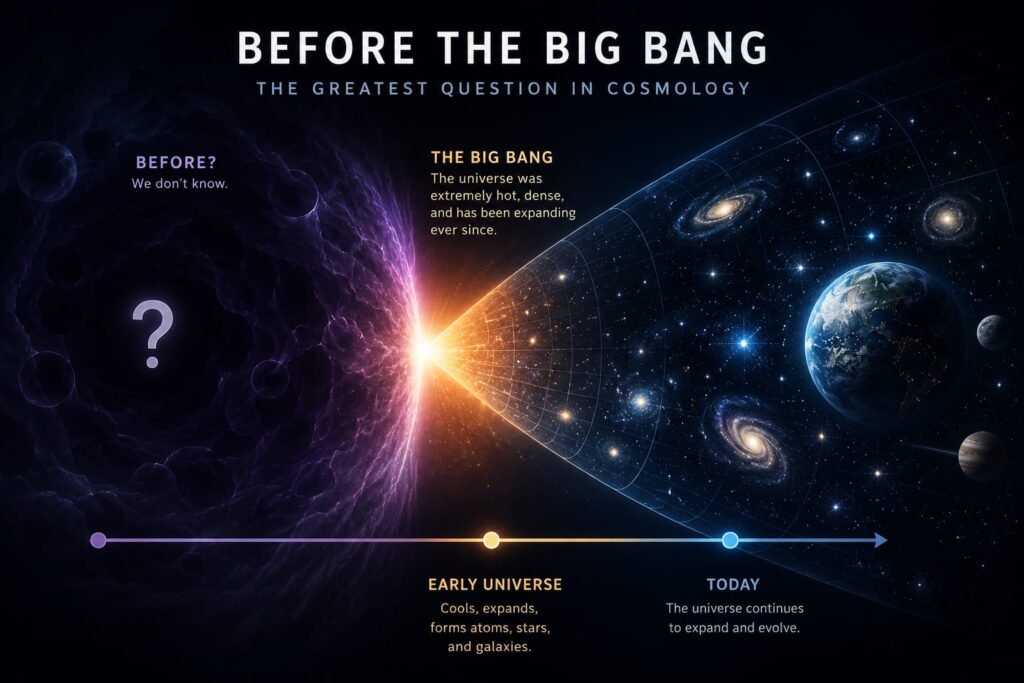
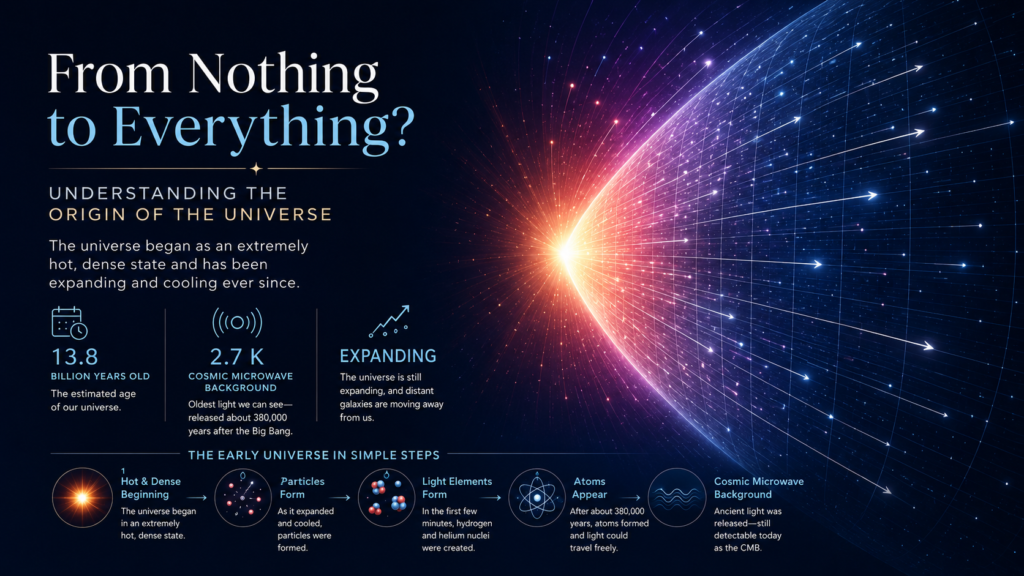
The cosmic microwave background preserves a snapshot of the universe when it was about 380,000 years old. Its tiny temperature differences correspond to variations in the density of matter in the early universe. Over much longer periods, gravity amplified these initial differences. NASA explains how these early fluctuations became the seeds of later cosmic structure.
At this point, there were no galaxies shining across space. The universe was still entering its long period of darkness before the first stars appeared.
The important thing is that the early universe already contained the seeds of structure. Galaxies did not have to emerge from a completely uniform universe.
Gravity Turned Small Differences Into Larger Structures
Gravity is the key to the process.
Suppose one region contains slightly more matter than another. Its stronger gravitational pull attracts additional matter from its surroundings. As more matter gathers there, the gravitational pull becomes stronger, which allows still more matter to collect.
Over time, a tiny difference can become a much larger concentration of matter.
This process happened throughout the young universe. Small structures grew into larger ones, creating the framework from which galaxies could eventually develop.
The process was not a sudden collapse of the entire universe. It was a gradual growth of structure under gravity.
Dark Matter Provided the Gravitational Framework
Ordinary matter alone does not explain how cosmic structures grew so efficiently.
Dark matter does not emit, absorb, or reflect light in the way ordinary matter does, but it has mass and therefore gravity. Its gravitational influence plays a major role in modern models of how galaxies and larger cosmic structures developed.
As the universe evolved, dark matter gathered into increasingly dense regions called dark matter halos.
A dark matter halo is a region dominated by dark matter whose gravity can hold surrounding matter together. It is not a galaxy by itself. Instead, it provides an important gravitational environment in which ordinary matter can gather.
This distinction matters.
It would be misleading to say that dark matter simply “made” the first galaxies. A better description is that growing dark matter halos provided much of the gravitational framework in which gas could collect, cool, and eventually form stars.
From Small Halos to Larger Structures
The earliest dark matter structures were relatively small.
They could grow by attracting more matter and by merging with other structures. As some halos became more massive, their gravitational pull became strong enough to gather increasing amounts of ordinary gas.
This is part of the hierarchical picture of structure formation: smaller structures can become building blocks for larger ones.
The process did not happen everywhere at the same rate. Some regions became denser earlier than others, while other regions remained relatively empty.
Over time, this uneven growth produced the beginnings of the large-scale structure that eventually included galaxies, groups, clusters, and the cosmic web.
How Did Gas Enter the First Galaxies?
Dark matter could provide the gravitational framework, but a galaxy also needed ordinary matter.
After the early universe cooled enough for atoms to form, ordinary matter was dominated by hydrogen and helium, with very small amounts of other light elements.
As dark matter halos grew, their gravity attracted this gas.
The gas moved into the growing gravitational wells and became increasingly concentrated. But simply gathering gas was not enough to create a galaxy filled with stars.
The gas also had to lose energy and become dense enough for stars to form.
Cooling Made Star Formation Possible
Gas that loses energy can contract under gravity.
In the early universe, the available cooling processes were different from those in modern, chemically enriched galaxies because the gas contained very few heavy elements.
As gas accumulated inside growing halos, cooling allowed parts of it to become denser. Eventually, some of these dense regions became the sites where the first stars formed.
The detailed process of how the first stars formed belongs to the earlier article in this series, How Did the First Stars Form? Here, the important connection is simpler: growing halos supplied the gravitational environment, while cooling gas supplied the material from which stars could form.
A first galaxy therefore required more than a collection of stars. It was the result of a growing gravitational structure containing gas and, eventually, stars.
Did the First Stars Come Before the First Galaxies?
The answer is more complicated than a simple timeline.
It is tempting to imagine that one star formed first, followed by another, and that enough stars eventually gathered together to create a galaxy.
The early universe was not that orderly.
The first stars formed inside small dark-matter-dominated structures. Some of these structures may have hosted only one or a small number of stars. As halos grew and accumulated more gas, they could support increasingly complex stellar systems.
That makes the boundary between the earliest star-forming structures and the first galaxies difficult to define.
A galaxy is not simply a group of stars sitting close together. It is a gravitationally bound system containing stars, gas, dark matter, and the interactions between them.
So the first galaxies were not created at one clearly defined moment when the first stars suddenly came together.
They emerged as growing structures accumulated enough matter and stars to become recognizable galactic systems.
The First Galaxies Were Small Beginnings
The earliest galaxies were very different from mature galaxies such as the Milky Way.
They were generally much younger and less chemically enriched. Their stars formed from material that had experienced far fewer generations of stellar processing than the gas from which most nearby stars formed.
Some early systems were probably compact and irregular rather than resembling the familiar spiral galaxies seen in the nearby universe.
Even so, they were already important structures.
They provided environments where gas could continue forming stars, while the stars themselves began changing the physical and chemical conditions around them.
What Happened When the First Galaxies Began to Shine?
Once stars formed inside these early systems, they became sources of light.
That light affected more than the appearance of the galaxies.
Massive early stars produced intense ultraviolet radiation. This radiation could interact with the surrounding hydrogen gas and contribute to the gradual transformation of the early universe during the period known as the Epoch of Reionization.
The stars also changed their surroundings in another important way.
When massive stars died, some of their deaths released heavier elements into the surrounding gas. These elements had not been abundant in the early universe. Their appearance changed the material available for later generations of stars.
Astronomers have even found evidence of elements such as oxygen in some very early galaxies. For example, observations of JADES-GS-z14-0 indicate that multiple generations of massive stars may already have lived and died before the galaxy’s light reached us. NASA’s Webb observations describe this evidence in detail.
This tells us something important about galaxy formation: once the first stars appeared, they began influencing the next stages of their galaxies’ development.
When Did the First Galaxies Form?
There is no scientifically established date for the birth of the first galaxy.
Galaxy formation was a gradual process rather than a single event. Different structures formed and grew at different times, and the earliest objects may have been much smaller and fainter than the galaxies we can observe today.
NASA describes the first few hundred million years after the Big Bang as the period when the first stars and galaxies began to emerge. NASA’s overview of the early universe explains how Webb is being used to study this period.
Modern observations have taken astronomers surprisingly close to this era.
The James Webb Space Telescope has confirmed galaxies from less than 300 million years after the Big Bang. One of these, JADES-GS-z14-0, was measured at a redshift of 14.32 and existed less than 300 million years after the Big Bang. NASA’s spectroscopic observations provide the measurement.
Since then, Webb observations have pushed the known record even earlier. NASA reports that MoM-z14, confirmed at a redshift of 14.44, existed about 280 million years after the Big Bang. NASA’s current early-universe summary lists MoM-z14 as the current record holder.
But there is an important distinction.
The earliest galaxy we have observed is not necessarily the first galaxy that formed.
A telescope can only detect objects whose light is strong enough to reach us and whose signals can be separated from the surrounding background. Earlier galaxies may have existed but remained too faint for current instruments to detect.
The exact first galaxy remains unknown.
How Did the First Galaxies Grow?
The formation of a first galaxy was not the end of the process.
Its dark matter halo could continue gathering matter. Additional gas could fall into the growing gravitational structure and provide material for new stars.
Nearby structures could also interact and merge.
Over time, these processes allowed early galaxies to become larger and more complex.
This helps explain why galaxy formation is better understood as a process of growth than as a single moment of creation.
The first galaxies were early stages in a much longer history. They provided the foundations from which later generations of galaxies developed.
The detailed story of how galaxies changed, merged, developed different shapes, and became systems like the Milky Way belongs to the next stage of this series.
How Do We Know the First Galaxies Existed?
One of the simplest ideas in observational astronomy is also one of the most powerful: looking farther away means looking further back in time.
Light travels at a finite speed.
When we observe the Sun, we see it as it was about eight minutes earlier. When astronomers observe a galaxy billions of light-years away, they see light that began its journey billions of years ago.
This allows telescopes to study galaxies at different stages of cosmic history.
The James Webb Space Telescope is particularly useful for this work because it observes infrared wavelengths. As light travels through an expanding universe, its wavelength is stretched toward longer wavelengths, a phenomenon called redshift.
Ancient starlight that was originally emitted at shorter wavelengths can therefore reach us in the infrared.
Webb’s observations have revealed galaxies from a period when the universe was only a few hundred million years old. These observations do not show us the first galaxy directly, but they provide real examples of galaxies that existed remarkably early in cosmic history. NASA explains how Webb uses distant light to look back in time.
Astronomers also compare these observations with models of how dark matter, gas, stars, and gravity behave.
That combination is important.
The observations tell scientists what early galaxies actually looked like and how old their light is. Physical models help explain how structures capable of producing those galaxies could have developed.
Seeing an Early Galaxy Is Not the Same as Seeing the First Galaxy
This is one of the most important distinctions in the subject.
When astronomers discover a galaxy from very early cosmic history, they have not necessarily found the first galaxy ever formed.
They have found the earliest one detected so far.
There may be earlier and fainter systems that current telescopes cannot yet see.
That is why scientists distinguish between observed evidence and models of the earliest stages of galaxy formation.
We have direct observations of galaxies from extremely early times.
We have strong physical evidence that gravity caused matter to become increasingly clumped.
And we have models that connect these processes to the formation of the first galactic systems.
But the exact identity and formation time of the very first galaxy remain open questions.
The First Galaxies Were the Beginning
The first galaxies grew out of a universe that was initially far smoother than the one we see today.
Tiny differences in matter density gave gravity the seeds it needed. Dark matter gathered into growing halos. Ordinary gas fell into those gravitational structures and cooled. Dense pockets of gas formed stars, and some of these growing systems developed into the first galaxies.
There was no single moment when the universe suddenly became filled with galaxies.
It was a gradual process of structure growing under gravity.
The first galaxies were small compared with many galaxies today, but their importance was enormous. Their stars produced light, altered their surroundings, and began enriching the universe with heavier elements.
Those early systems became the starting points for the much larger and more complex galaxies that developed later.
We still do not know exactly which object deserves the title of the first galaxy.
What astronomers do know is that the process had already begun remarkably early. Webb’s observations are allowing scientists to see closer to that beginning, while models of cosmic structure help explain how the first galactic systems could have emerged.
The story of how those early galaxies evolved into the diverse galaxies we see today is the next part of the cosmic story.
Frequently Asked Questions
How did the first galaxies form?
The first galaxies developed as gravity amplified small density differences in the young universe. Dark matter gathered into growing halos, ordinary gas fell into these gravitational structures, the gas cooled, and stars formed within them. As these structures accumulated more matter and stars, some developed into the earliest galaxies.
When did the first galaxies form?
Scientists do not know the exact time when the first galaxy formed. Webb has confirmed galaxies from less than 300 million years after the Big Bang, and observations have now reached about 280 million years after the Big Bang. These are the earliest galaxies observed so far, not necessarily the first galaxies that ever existed.
Did dark matter create the first galaxies?
Not by itself. Dark matter does not directly form stars or emit the light that makes galaxies visible. Its gravity helped create halos that provided an important framework for ordinary gas to gather, cool, and form stars.
Did stars form before galaxies?
The distinction is not completely straightforward. The earliest stars formed inside small dark-matter-dominated structures, and some of those structures may have contained only a few stars. As these structures grew and accumulated more gas and stars, increasingly complex galactic systems emerged.
What were the first galaxies made of?
They contained dark matter, primordial gas dominated by hydrogen and helium, and the first generations of stars. As stars lived and died, they produced heavier elements that gradually enriched the gas inside and around these early systems.
Has the first galaxy ever been found?
No. Astronomers have observed galaxies from extremely early cosmic times, but the earliest observed galaxy is not necessarily the first galaxy that formed. Earlier and fainter galaxies may still be beyond our ability to detect.