The universe is expanding, but scientists discovered that its expansion is not slowing down. It is accelerating. So how do scientists know dark energy exists if they cannot see it?
The answer comes from measuring how the universe has expanded over time. Distant supernovae, observations of the cosmic microwave background, and measurements of large-scale cosmic structure all provide evidence that the universe contains something affecting its expansion. Scientists call this unknown component dark energy.
The first major clue came from distant supernovae
For a long time, scientists expected gravity to slow the expansion of the universe. Matter attracts other matter, so the expansion should gradually lose speed.
In 1998, two independent teams studying distant Type Ia supernovae found something unexpected. These explosions have a fairly consistent intrinsic brightness, so astronomers can use them to estimate their distance. They can then compare that distance with the supernova’s redshift, which shows how much its light has been stretched by the expansion of space.
The distant supernovae appeared fainter than expected. That meant they were farther away than they should have been if cosmic expansion had simply been slowing under gravity.
The simplest interpretation was that the expansion of the universe had changed and was accelerating.
This discovery earned Saul Perlmutter, Brian Schmidt and Adam Riess the 2011 Nobel Prize in Physics.
Why does an accelerating universe point to dark energy?
Finding acceleration tells scientists what the universe is doing, but not necessarily what is causing it.
In the standard cosmological model, the observed acceleration is explained by a component called dark energy. It behaves differently from ordinary matter: as the universe expands, dark energy does not dilute in the same way that matter does.
Scientists therefore use the term “dark energy” for the unknown component responsible for the observed accelerated expansion.
That does not mean scientists have directly detected a new substance. They have measured its apparent effect on the universe.
Other observations support the same picture
Scientists did not base the idea of dark energy on supernovae alone. Other observations provide independent information about the universe’s history and composition.
The cosmic microwave background provides an early snapshot
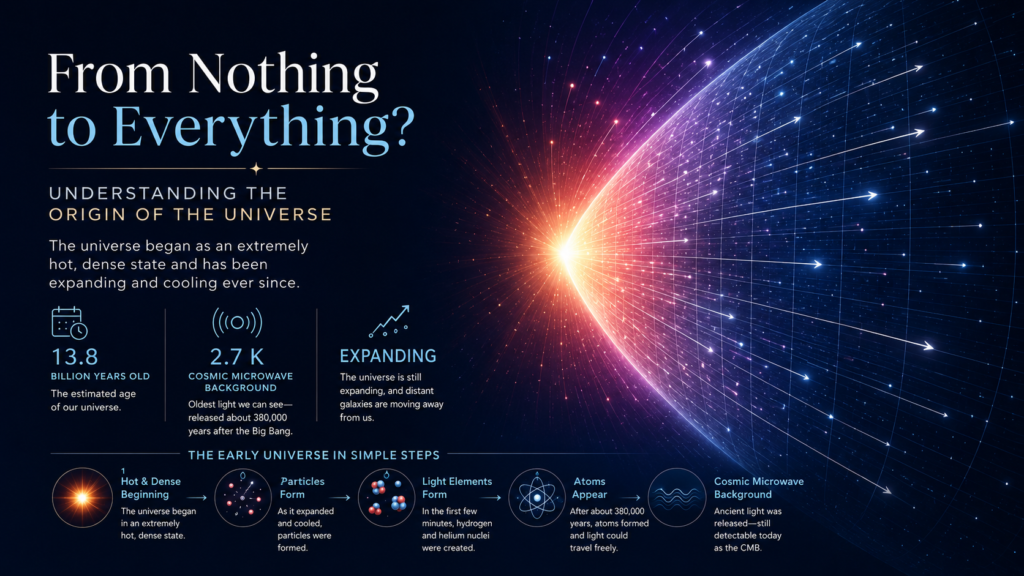
The cosmic microwave background, or CMB, is faint radiation left over from the early universe. It gives scientists a picture of the universe when it was much younger.
By studying its tiny temperature variations, scientists can determine important properties of the early universe. They can then compare that picture with observations of the universe today.
That comparison supports a universe whose present expansion cannot be explained by matter alone. A component with the properties attributed to dark energy is required in the standard cosmological model.
The cosmic web gives another test
Galaxies are arranged in enormous structures called the cosmic web, made up of galaxies, galaxy clusters and vast regions with relatively little matter.
Gravity causes matter to gather and structures to grow. The rate at which those structures formed over cosmic history depends on how the universe expanded.
Measurements of galaxies and other large-scale structures therefore give scientists another way to test the expansion history.
These observations broadly support the same cosmological picture in which dark energy plays a major role in the universe’s recent expansion.
Scientists can trace when the expansion changed
Looking farther into space means looking farther into the past because light takes time to reach us.
This allows astronomers to compare the expansion of the universe at different stages of its history.
Observations indicate that the universe was once in a period when gravity from matter was slowing the expansion. Later, the expansion began accelerating.
NASA’s observations of distant supernovae have provided evidence for this transition, helping scientists study how cosmic expansion changed over billions of years.
This is important because dark energy is not being inferred from one measurement at one moment. Scientists can examine how the expansion changed across cosmic time.
Is dark energy the same as dark matter?
No.
The two names are often confused, but they describe different effects.
Dark matter is used to explain extra gravitational effects that help hold galaxies and larger structures together.
Dark energy is used to explain the observed acceleration of the universe’s expansion.
Dark matter helps explain why matter gathers. Dark energy is associated with why cosmic expansion is accelerating.
Neither term means scientists have directly photographed the thing itself.
Do scientists know exactly what dark energy is?
No. This is where the evidence ends and the unanswered questions begin.
Scientists have strong evidence that the expansion of the universe is accelerating. The term dark energy describes the unknown component used to explain that observation within the standard cosmological model.
But its physical nature remains unknown.
One possibility is the cosmological constant, a term in Einstein’s equations associated with the energy of empty space. Other models propose that dark energy could change with time or that our understanding of gravity may need modification.
These are scientific possibilities, not established facts. NASA currently describes the nature of dark energy as an open question.
So, how do scientists know dark energy exists?
Scientists do not know dark energy exists because they have seen it directly.
They know that the universe’s expansion is accelerating, and several independent observations support that conclusion.
Distant supernovae provided the first major evidence. The cosmic microwave background gives information about the early universe. Observations of galaxies and large-scale cosmic structure provide additional tests of how the universe has evolved.
Dark energy is the name scientists give to whatever is responsible for the observed acceleration.
The acceleration is well supported by observations. What dark energy actually is remains one of the major unanswered questions in cosmology.
The universe is expanding, but scientists discovered that its expansion is not slowing down. It is accelerating. So how do scientists know dark energy exists if they cannot see it?
The answer comes from measuring how the universe has expanded over time. Distant supernovae, observations of the cosmic microwave background, and measurements of large-scale cosmic structure all provide evidence that the universe contains something affecting its expansion. Scientists call this unknown component dark energy.
The first major clue came from distant supernovae
For a long time, scientists expected gravity to slow the expansion of the universe. Matter attracts other matter, so the expansion should gradually lose speed.
In 1998, two independent teams studying distant Type Ia supernovae found something unexpected. These explosions have a fairly consistent intrinsic brightness, so astronomers can use them to estimate their distance. They can then compare that distance with the supernova’s redshift, which shows how much its light has been stretched by the expansion of space.
The distant supernovae appeared fainter than expected. That meant they were farther away than they should have been if cosmic expansion had simply been slowing under gravity.
The simplest interpretation was that the expansion of the universe had changed and was accelerating.
This discovery earned Saul Perlmutter, Brian Schmidt and Adam Riess the 2011 Nobel Prize in Physics.
Why does an accelerating universe point to dark energy?
Finding acceleration tells scientists what the universe is doing, but not necessarily what is causing it.
In the standard cosmological model, the observed acceleration is explained by a component called dark energy. It behaves differently from ordinary matter: as the universe expands, dark energy does not dilute in the same way that matter does.
Scientists therefore use the term “dark energy” for the unknown component responsible for the observed accelerated expansion.
That does not mean scientists have directly detected a new substance. They have measured its apparent effect on the universe.
Other observations support the same picture
Scientists did not base the idea of dark energy on supernovae alone. Other observations provide independent information about the universe’s history and composition.
The cosmic microwave background provides an early snapshot
The cosmic microwave background, or CMB, is faint radiation left over from the early universe. It gives scientists a picture of the universe when it was much younger.
By studying its tiny temperature variations, scientists can determine important properties of the early universe. They can then compare that picture with observations of the universe today.
That comparison supports a universe whose present expansion cannot be explained by matter alone. A component with the properties attributed to dark energy is required in the standard cosmological model.
The cosmic web gives another test
Galaxies are arranged in enormous structures called the cosmic web, made up of galaxies, galaxy clusters and vast regions with relatively little matter.
Gravity causes matter to gather and structures to grow. The rate at which those structures formed over cosmic history depends on how the universe expanded.
Measurements of galaxies and other large-scale structures therefore give scientists another way to test the expansion history.
These observations broadly support the same cosmological picture in which dark energy plays a major role in the universe’s recent expansion.
Scientists can trace when the expansion changed
Looking farther into space means looking farther into the past because light takes time to reach us.
This allows astronomers to compare the expansion of the universe at different stages of its history.
Observations indicate that the universe was once in a period when gravity from matter was slowing the expansion. Later, the expansion began accelerating.
NASA’s observations of distant supernovae have provided evidence for this transition, helping scientists study how cosmic expansion changed over billions of years.
This is important because dark energy is not being inferred from one measurement at one moment. Scientists can examine how the expansion changed across cosmic time.
Is dark energy the same as dark matter?
No.
The two names are often confused, but they describe different effects.
Dark matter is used to explain extra gravitational effects that help hold galaxies and larger structures together.
Dark energy is used to explain the observed acceleration of the universe’s expansion.
Dark matter helps explain why matter gathers. Dark energy is associated with why cosmic expansion is accelerating.
Neither term means scientists have directly photographed the thing itself.
Do scientists know exactly what dark energy is?
No. This is where the evidence ends and the unanswered questions begin.
Scientists have strong evidence that the expansion of the universe is accelerating. The term dark energy describes the unknown component used to explain that observation within the standard cosmological model.
But its physical nature remains unknown.
One possibility is the cosmological constant, a term in Einstein’s equations associated with the energy of empty space. Other models propose that dark energy could change with time or that our understanding of gravity may need modification.
These are scientific possibilities, not established facts. NASA currently describes the nature of dark energy as an open question.
So, how do scientists know dark energy exists?
Scientists do not know dark energy exists because they have seen it directly.
They know that the universe’s expansion is accelerating, and several independent observations support that conclusion.
Distant supernovae provided the first major evidence. The cosmic microwave background gives information about the early universe. Observations of galaxies and large-scale cosmic structure provide additional tests of how the universe has evolved.
Dark energy is the name scientists give to whatever is responsible for the observed acceleration.
The acceleration is well supported by observations. What dark energy actually is remains one of the major unanswered questions in cosmology.